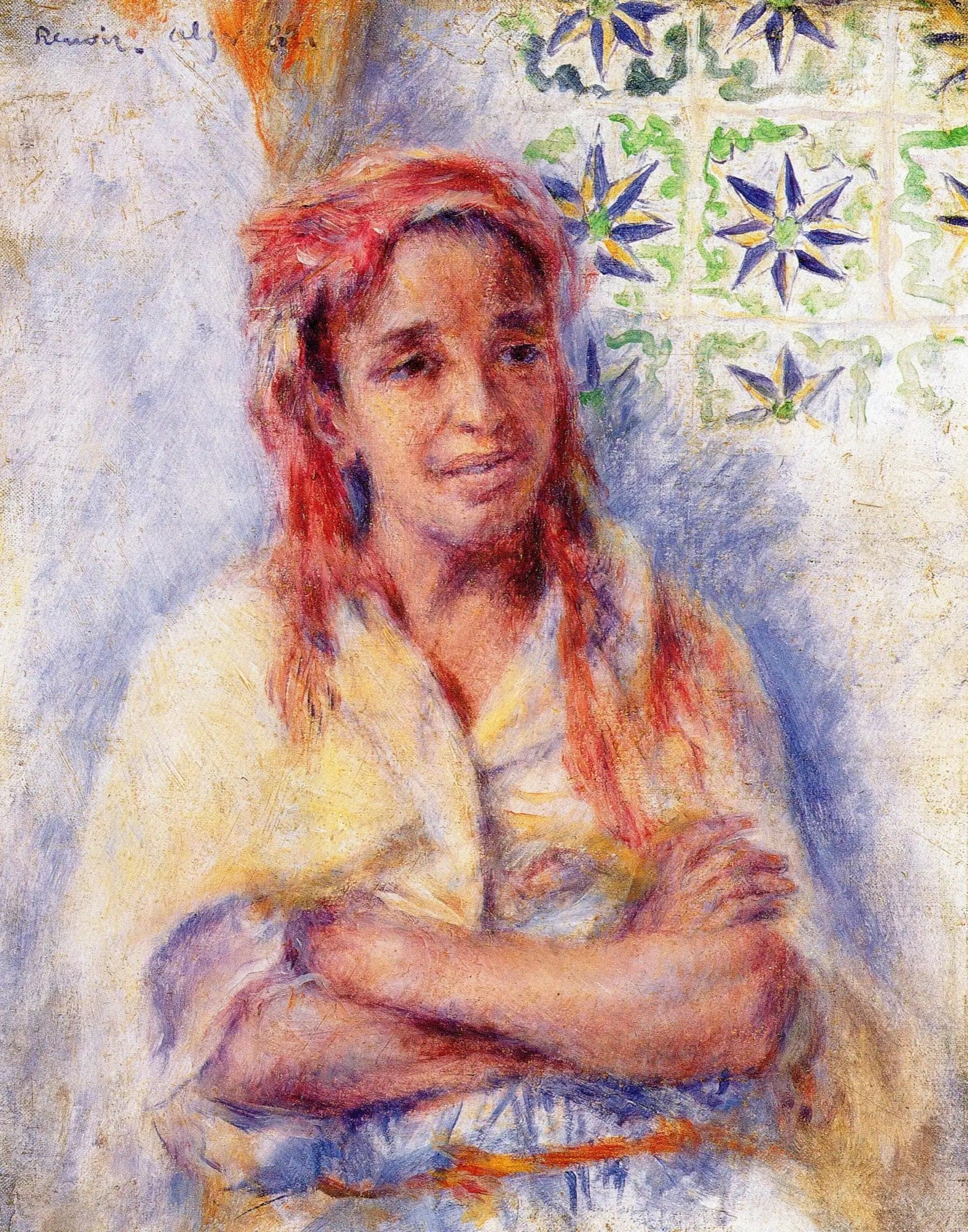
Portrait of an Old Arab Woman - Pierre
- Original dimensions
- 24 x 29.8 cm
- Museum
- Worcester Art Museum
- Year
- 1882
Scene depicted
This painting invites us to explore a tender scene, where the face of this old Arab woman reveals itself in all its dignity and serenity. The nuances of her skin tell centuries of stories, while her gaze imparts depth to the work. Renoir captures not only a moment but also a timeless emotion, connecting us to humanity across the ages.
Historical context
Created in 1882, this painting is set against the cultural backdrop of the late 19th century, at a time when the Impressionist movement, of which Renoir is a pioneer, begins to revolutionize the presentation of light and color. The painting is currently housed in the Worcester Art Museum , where it continues to evoke the profound humanity of its subjects while offering a window into the world of yesteryear.
Place in the artist's career
The Portrait of an Old Arab Woman sits at the crossroads of the beginning of Renoir's maturity, marking a shift towards the representation of human emotions. In parallel with his painting “Luncheon of the Boating Party” and “Dance at Bougival,” this painting subtly illustrates an evolution towards a more intimate and personal approach, while retaining the vibrant light that is characteristic of his work.
Anecdote
Renoir once stated: “The most difficult thing to paint is light.” In an alley of the East, he encountered this old woman with a weathered face, bathed in golden light, inspiring a pictorial work that captures not only her image but also her soul. Each brushstroke in this painting reveals the fleeting beauty of human existence.