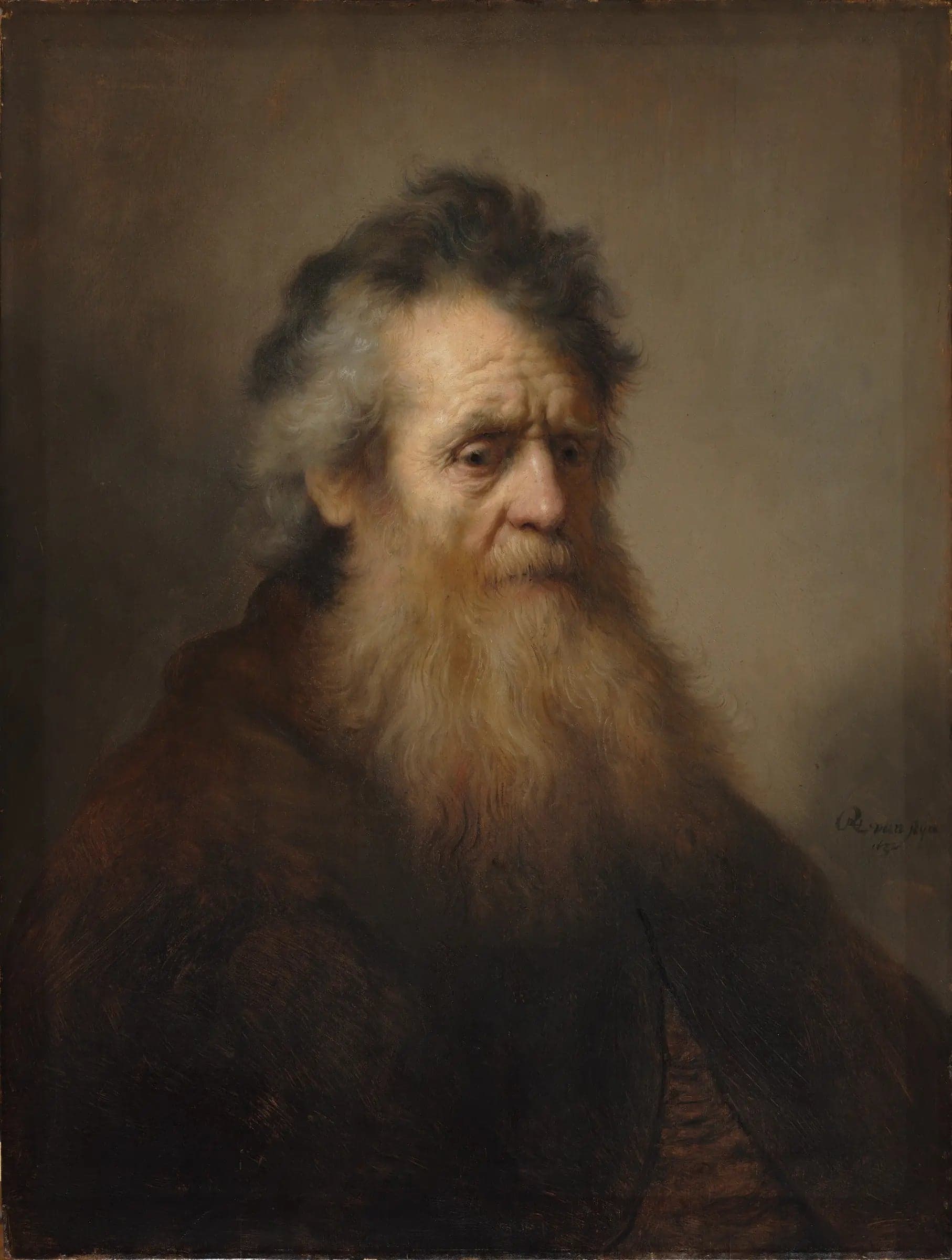
Portrait of an elderly man
- Original dimensions
- 112 x 128 cm
- Museum
- Calouste-Gulbenkian Museum
- Year
- 1645
Scene depicted
In this iconic painting, Rembrandt explores the themes of wisdom and contemplation. The man, deeply aged, is captured in a moment of introspection, his thoughtful eyes telling a life story that only a masterpiece canvas can unveil. The folds of his skin and the fiery hues of his beard testify to a life rich in experiences.
Historical context
Created in 1645, in the heart of Amsterdam bathed by the seraphic light of the canals, this painting is part of the Baroque movement. Rembrandt , the undisputed master of shadow and light, immortalizes here the face of an old man, a symbol of the wise and the bearers of stories. The current canvas is preserved at the Calouste-Gulbenkian Museum in Lisbon, a treasure for art lovers who can admire the impressive dimensions of this work.
Place in the artist's career
The Portrait of an Old Man is situated at the crossroads of Rembrandt 's artistic maturity, unfolding in a style that merges the technical rigor of his beginnings with raw emotion. Alongside “The Night Watch” and “The Return of the Prodigal Son,” this painting reveals a marked evolution, where the psychological depth of the subject becomes central.
Anecdote
“In every line, a life unfolds, and in every shadow, a whispered secret.” These words of Rembrandt resonate like an echo of his genius. Inspired by the melodic voice of a distant violin, he captured the delicate expression of his subject, revealing the human soul through a simple gaze.