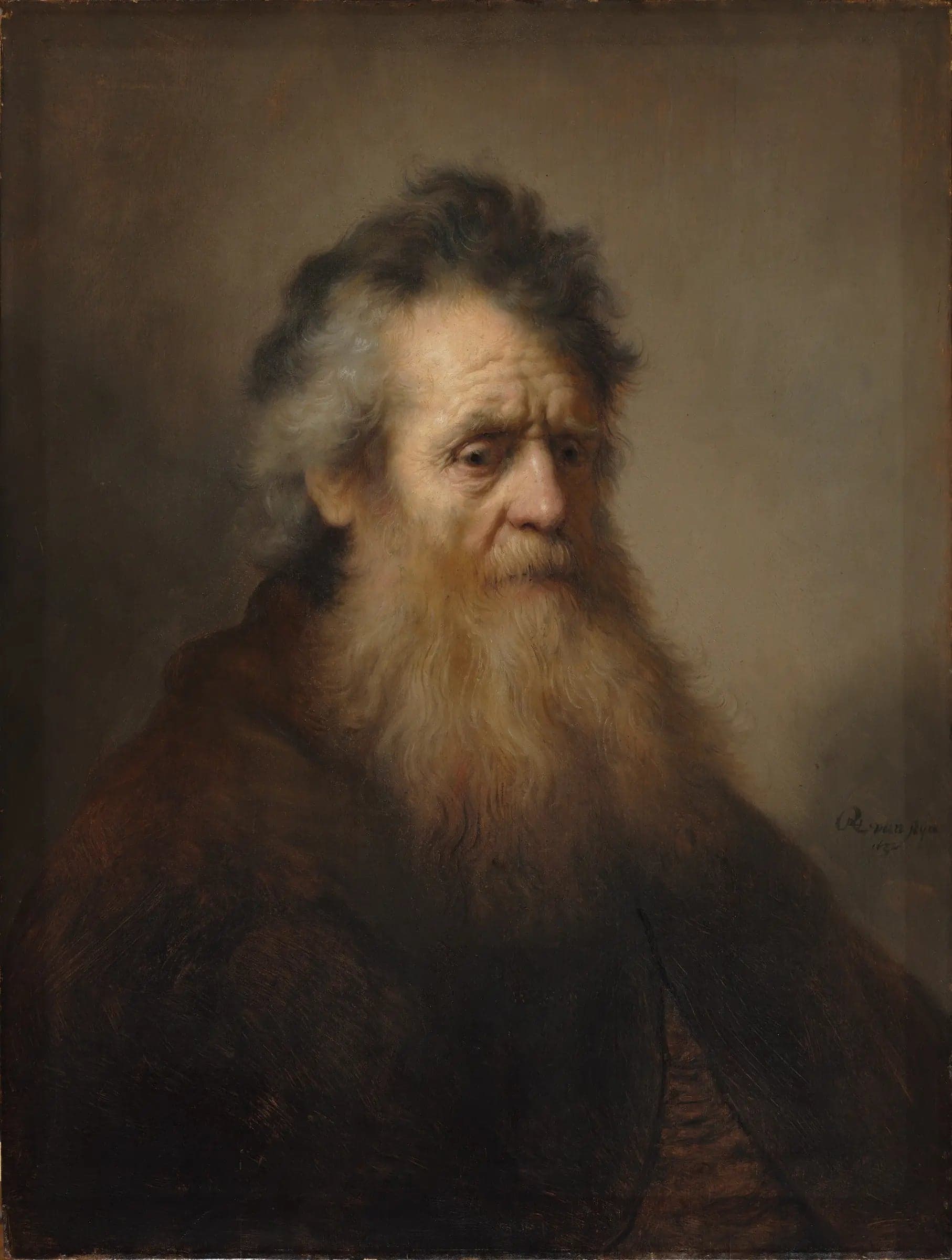
Portrait of an elderly man
- Original dimensions
- 50.7 x 66.9 cm
- Museum
- Augusteum
- Year
- 1632
Scene depicted
In the painting “Portrait of an Old Man,” Rembrandt offers a snapshot of a man's life, his features sculpted by the years and trials. Every detail of this pictorial work narrates a story, created by a subtle play of light and shadow, transporting the viewer into a reflection on the passage of time.
Historical context
Painted in 1632, in the vibrant context of the Netherlands, during an artistic period marked by the baroque , this canvas illustrates the mastery of Rembrandt . Currently preserved at the Augusteum Museum, this painting reveals a historical and emotional richness that transcends time.
Place in the artist's career
This Portrait of an Old Man is at the heart of Rembrandt's artistic career, marking a turning point towards a more sincere and introspective exploration of human emotions. In parallel, his other productions, such as “The Night Watch” and “Self-Portrait with Grey Fur,” testify to his constantly evolving technique and his ability to capture human depth.
Anecdote
“I wanted to capture not only the appearance but also the soul of the man,” stated Rembrandt while contemplating his model. Imagine the soft glow of a spring morning, when the artist sketched this masterpiece , inspired by the face marked by experience, a poignant reflection of wisdom and temperance.