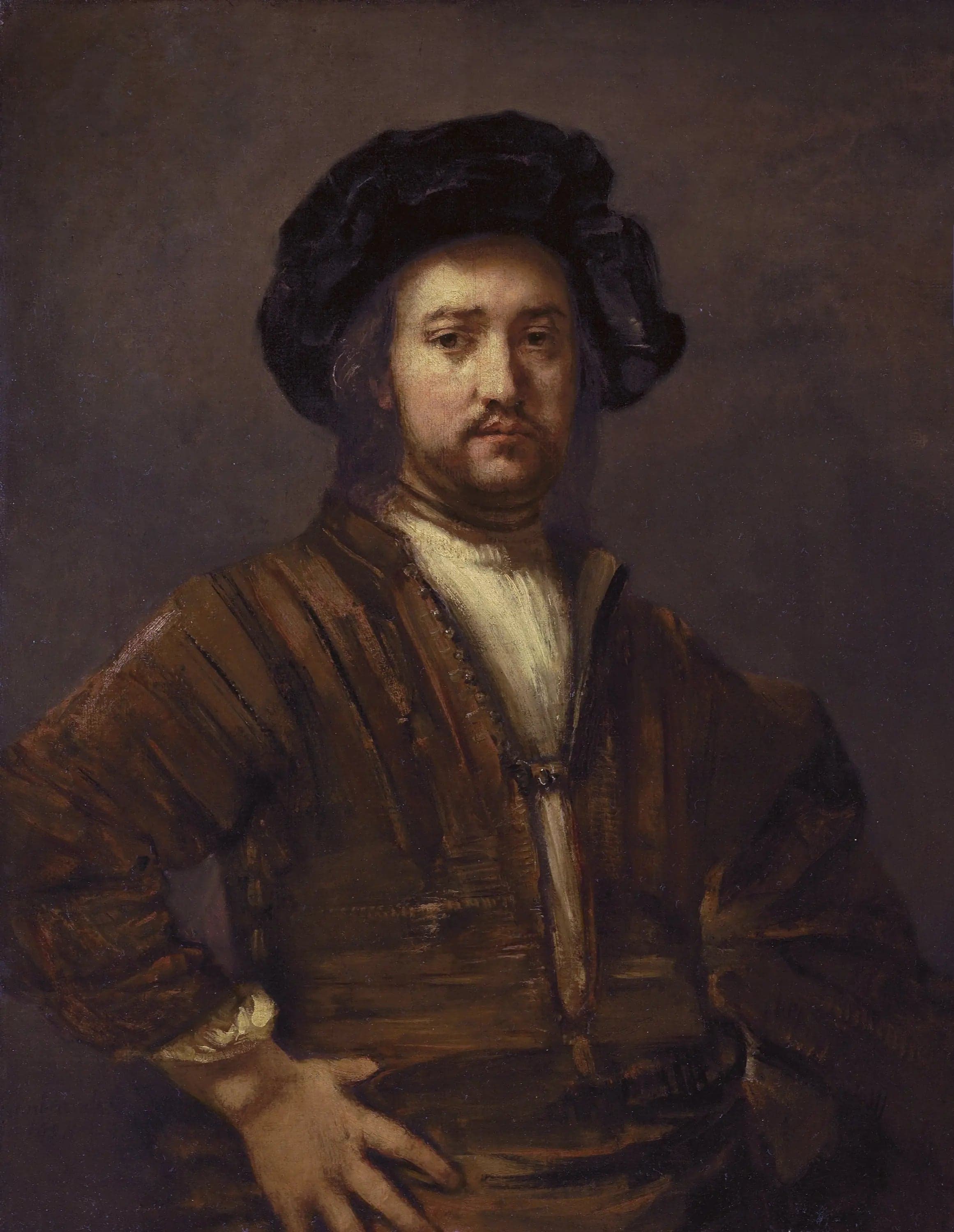
Portrait of an Admiral
- Original dimensions
- 87 x 107.4 cm
- Movement
- Dutch Golden Age
- Museum
- Agnes Etherington Art Centre
- Year
- 1658
Scene depicted
The painting “Portrait of an Admiral” depicts a man of importance, draped in an emblematic uniform that underscores his medial status and authority. In a solemn pose, the admiral seems to challenge the horizon, looking beyond the canvas towards the maritime challenges that await him. Every detail, from the reflection of light on his gold buttons to the slight movement of his coat, tells a story of honor and bravery, an echo of the tumultuous life of the seas.
Historical context
This painting emblematic was born in the heart of the Dutch Golden Age, a flourishing period that infused the city of Amsterdam with light and creativity. In 1658, as the winds of history blew across Europe, Rembrandt sublimates the art of portraiture and immortalizes the authority of an admiral with unparalleled psychological depth. Currently exhibited at the Agnes Etherington Art Centre, this work of remarkable dimensions (87 x 107.4 cm) embodies the very essence of exceptional artistic craftsmanship.
Place in the artist's career
This essential work illustrates a stylistic peak in Rembrandt 's career, marking a turning point in his exploration of psychological portraits. In parallel with “The Night Watch” and “The Anatomy Lesson of Dr. Tulp,” we observe an evolution in the mastery of light and shadow, culminating in this painting that captivates both by its depth and expressiveness.
Anecdote
“In every face I paint, I seek to capture the soul and heartbeat of the individual,” said Rembrandt . This quote resonates deeply with the genesis of this masterpiece , born on a misty morning in Amsterdam, where the silence was only disturbed by the gentle whisper of the brush on the canvas. This moment of inspiration gave rise to a painting vibrant, a reflection of a port life that the admiral embodies with as much nobility as humility.