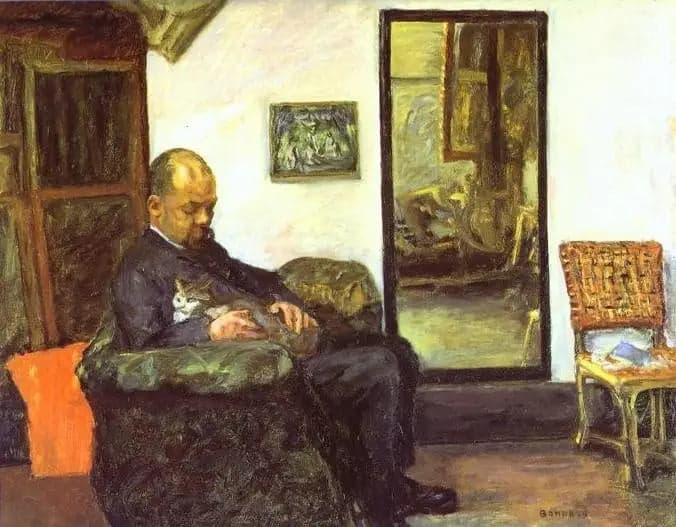
Portrait of Ambroise Vollard
- Original dimensions
- 93 x 74 cm
- Museum
- Kunsthaus de Zurich
- Year
- 1904
Scene depicted
The painting “Portrait d'Ambroise Vollard” depicts the illustrious art dealer Ambroise Vollard, an essential figure in the Parisian art market. Bonnard, through this portrait, captures both the intellect and sensitivity of his model, intertwining the personality and passion of a man devoted to promoting innovative talents. This painting transcends the simple portrait, becoming a reflection on creativity and the impact of art in society.
Historical context
Created at the beginning of the 20th century, this iconic painting is part of a period of artistic effervescence in France. Pierre Bonnard , a leading figure of the Nabi movement, transforms the portrait into a vibrant exploration of color and light. This painting , currently exhibited in Zurich, resonates with the spirit of an era marked by the awakening of the senses and artistic renewal, offering an immersion into the refined aesthetics of a bygone time.
Place in the artist's career
This painting is situated at the crossroads of Bonnard's career, between the beginning of his commitment as an artist and the affirmation of his unique style. In parallel with works like “Le Déjeuner” and “Les Grands Boulevards,” this portrait marks the evolution of his work, testifying to a growing mastery of light and color play, before becoming an essential figure in the artistic landscape.
Anecdote
“Light is my muse, my painting expresses it.” These words from Bonnard evoke the crucial importance of light in his creation. Inspired by the fleeting beauty of a spring morning, he captured not only the face of Ambroise Vollard but also the soul of the moment, the vibrant essence of an aesthete at the heart of his time. This masterpiece thus becomes an echo of human emotions, vibrating with palpable tenderness.