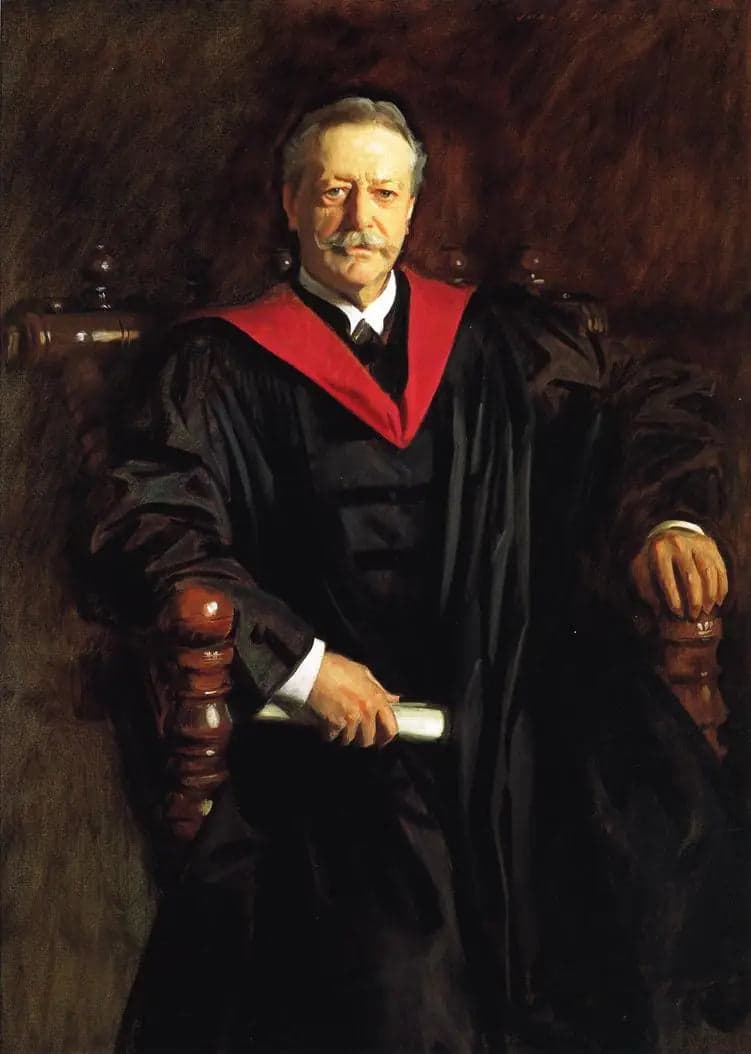
Portrait of Abbot Lawrence Lowell
- Original dimensions
- 38.78 x 55.35 cm
- Museum
- Not specified
- Year
- 1923
Scene depicted
The painting “Portrait of Abbot Lawrence Lowell” depicts a man with a thoughtful gaze, dressed with care, symbolizing the respect and admiration of a bygone era. Sargent, with his refined palette, manages to make the subject's contradictory emotions palpable: the authority of an abbot, mingled with human fragility. Every detail, from the texture of his clothing to the depth of his expression, creates a silent yet powerful narrative at the heart of this painting .
Historical context
Created in 1923, this painting is emblematic of the United Kingdom of the 1920s, a fertile period where the realistic movement blends with a modern approach. Although the current location of the painting is not specified, its presence in private collections attests to its importance in the history of art. The delicacy of the style and the penetrating gaze of the subject reveal the essence of the portrait within the pictorial work of John Singer Sargent , known for his talent in capturing the human soul on canvas.
Place in the artist's career
This painting , emblematic, represents a peak in Sargent's career. Just after his brilliant portraits of high society, “Portrait of Abbot Lawrence Lowell” falls within a period of artistic maturation. Placing it alongside works such as “Madame X” and “The Artist's Children,” one observes an evolution in his treatment of light and textures, revealing a depth and intimacy never seen before.
Anecdote
“Art is a mirror of the soul,” Sargent might have said one April morning, contemplating the serene face of Lawrence Lowell, inspired by the soft light filtering through the windows of his studio. This canvas is the result of a fleeting moment, where time freezes in the magic of a brushstroke, revealing an authentic and timeless emotion.