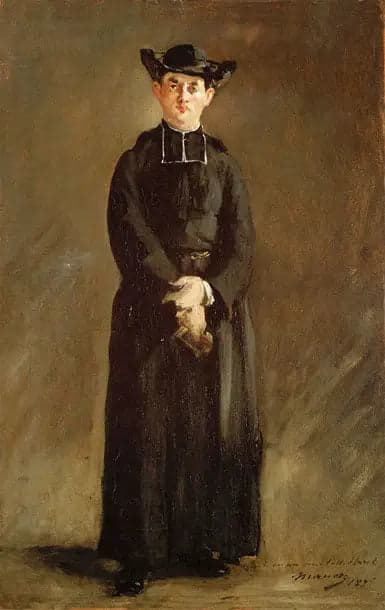
Portrait of Abbé Hurel
- Original dimensions
- 30 x 42 cm
- Museum
- Not specified
- Year
- 1875
Scene depicted
The painting depicts with captivating intensity the face of Abbé Hurel, revealing the soul of this clergyman through a penetrating gaze. The light gently caresses his figure, highlighting the fineness of the features in a subtle dialogue between shadow and clarity. The viewer is immediately drawn to the magic emanating from this frozen moment, where every detail is an invitation to reflection.
Historical context
The painting titled Portrait of Abbé Hurel emerges in 1875, in the heart of Paris, a city in full artistic effervescence. Édouard Manet , an emblematic figure of the Impressionist movement, exploits a bold and revolutionary style. In this vibrant context of creativity, this canvas bears witness to a moment when painting frees itself from conventions. Although the painting is not exhibited in a well-known museum, it is considered a pivotal work of the era, where each brushstroke tells a story rich in emotions.
Place in the artist's career
This painting stands out as a crucial step in Manet's career, situated between his promising beginnings and his stylistic peak. In parallel with works like Déjeuner sur l'herbe and Olympia , Portrait of Abbé Hurel demonstrates Manet's evolution, both technically and emotionally, affirming his mark in the history of art.
Anecdote
“Art is the magic of capturing the ephemeral.” In this perspective, Manet composed the masterpiece with particular attention. Inspired one radiant morning, he crossed paths with Abbé Hurel and, in a moment of illumination, the face of this clergyman took shape on his canvas , embodying a unique emotional depth.