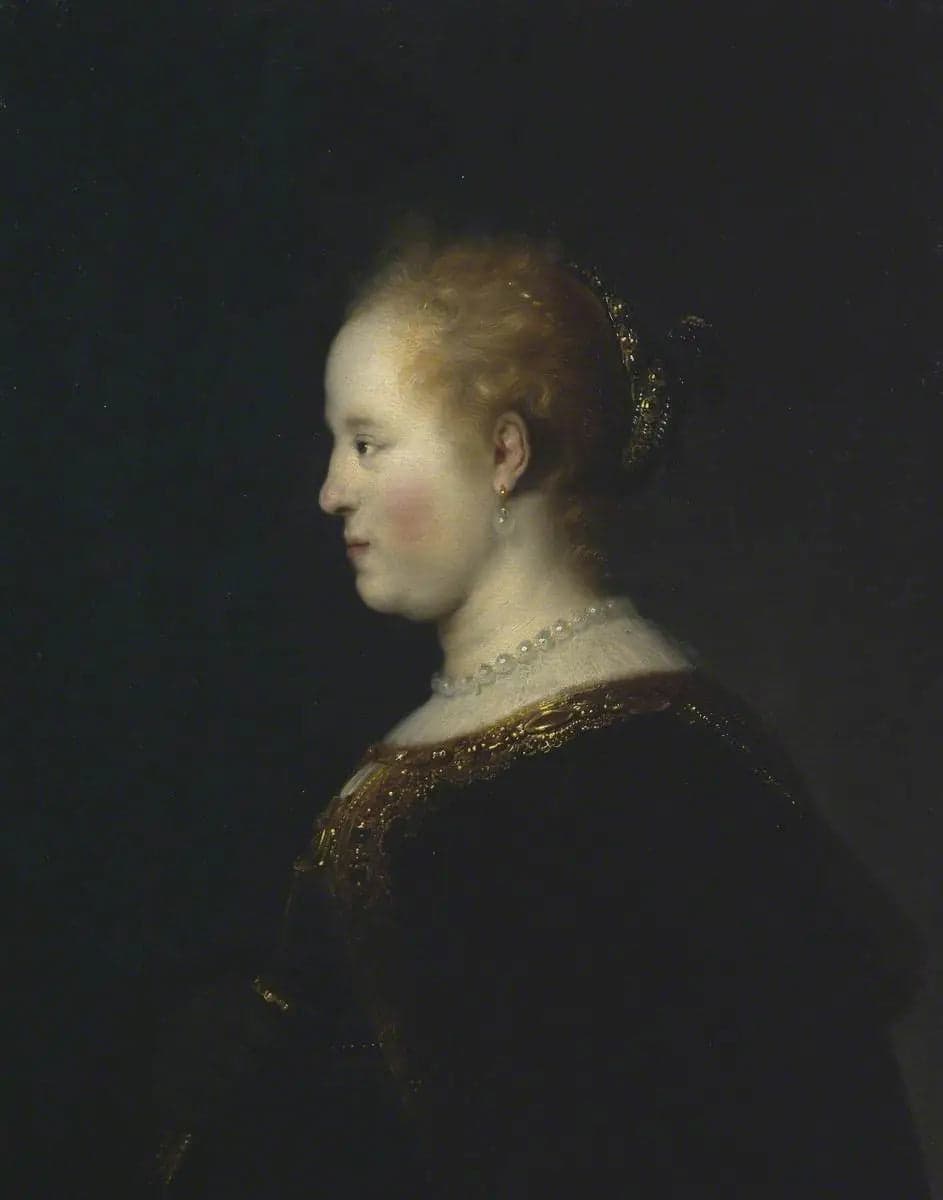
Portrait of a Young Woman
- Original dimensions
- 48 x 56.3 cm
- Museum
- Montreal Museum of Fine Arts
- Year
- 1665
Scene depicted
The canvas "Portrait of a Young Woman" presents a scene of rare delicacy, where the protagonist exudes unchanging grace. Her natural posture and deep gaze capture the essence of femininity while expressing poignant introspection. The play of shadows accentuates the contours of her face, subtly revealing her unique character. This pictorial work evokes a moment frozen in time, where each viewer can be carried away into the thoughts of the young woman.
Historical context
Created at the dawn of the Dutch golden age, this painting embodies the artistically vibrant setting of Amsterdam in the 17th century. It perfectly captures the baroque movement, opting for a subtle play of shadows and light, reflecting a time when individual expression took on a unique significance. Currently, this canvas is preserved at the Montreal Museum of Fine Arts , safeguarded for future generations. Its dimensions, though modest, reveal a great intimacy, conducive to close observation and immersion in the work.
Place in the artist's career
"Portrait of a Young Woman" marks a decisive turning point in the career of Rembrandt . It is a culmination of his mastery of chiaroscuro and an affirmation of his personal style. By comparing it with other works like "The Night Watch" and "The Anatomy Lesson of Dr. Tulp," one can trace the evolution of his artistic vision, from the monumental to the intimate.
Anecdote
Rembrandt once declared: "Every face tells a story, every gaze a chapter." Imagine the artist, brush in hand, capturing on canvas the enigmatic smile of a young woman one spring morning. In this soft and luminous atmosphere, each brushstroke becomes an echo of the pure emotion conveyed by the painting .