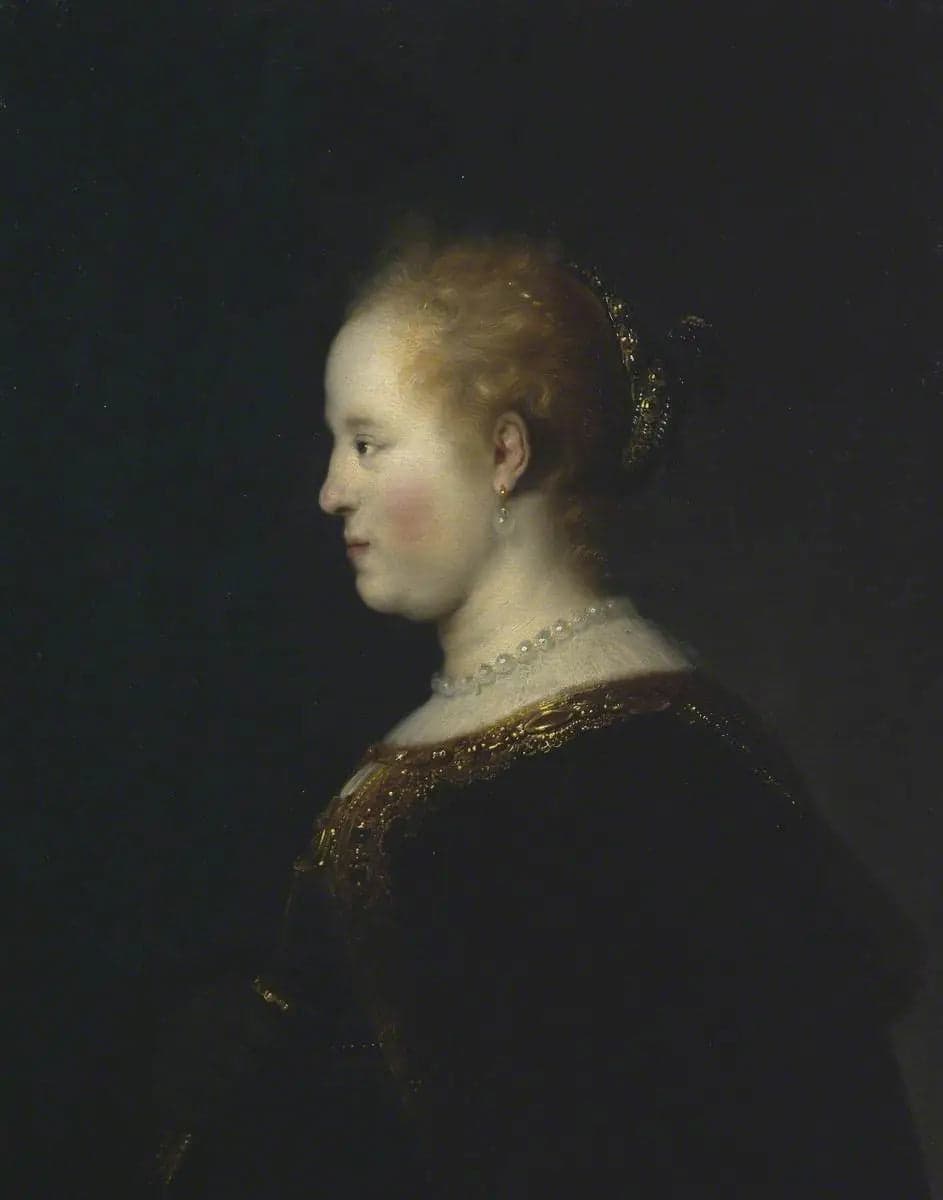
Portrait of a Young Woman
- Original dimensions
- 487.426 x 652.526 cm
- Museum
- Museum of Fine Arts, Houston
- Year
- 1633
Scene depicted
The canvas reveals a young woman, presented gracefully, in a serene pose, her gaze both thoughtful and engaging. Every detail of her adornment, from her starry garments to her delicate expression, testifies to Rembrandt 's skill in immortalizing not just a face, but a deep emotion. This captured moment becomes a window into the human soul, an echo of the past that still resonates today.
Historical context
Created in 1633, this painting embodies the heart of Amsterdam, a vibrant city flourishing during the Dutch Golden Age. Rembrandt van Rijn, a leading figure of the Baroque movement, captures a moment frozen in time, revealing not only beauty but also the complexity of the human soul. Currently, this canvas is carefully preserved at the Museum of Fine Arts, Houston, where its presence radiates through its impressive dimensions.
Place in the artist's career
The Portrait of a Young Woman represents one of the significant milestones in Rembrandt 's career, whose style evolves to reach striking maturity. This masterpiece from 1633 is at the heart of his exploration of light and shadow. In parallel, one can mention iconic works such as "The Night Watch" and "The Anatomy Lesson of Dr. Tulp," which construct a narrative arc of technical mastery and growing emotion.
Anecdote
Rembrandt , known for his ability to capture emotions, is said to have passionately declared: "Light is the key to every soul." Let us imagine that particular moment when he encountered this delicate face one spring morning, perhaps in an alley bathed in golden light, inspiring this pictorial work that transcends time and touches our hearts.