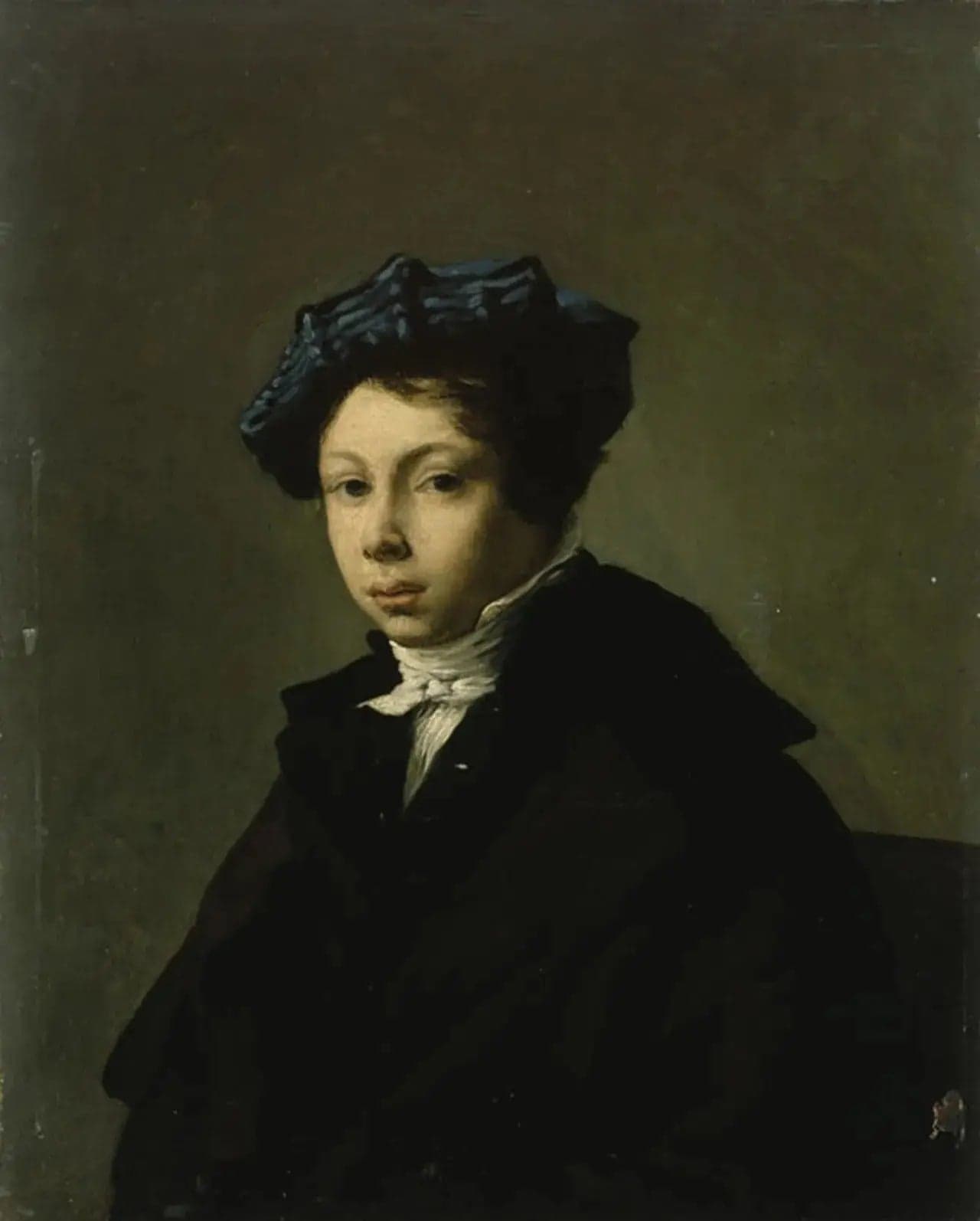
Portrait of a Young Man Wearing a Blue Beret
- Original dimensions
- 32 x 40 cm
- Museum
- national museum Eugène-Delacroix
- Year
- 1824
Scene depicted
In this painting, the artist depicts a young man with an introspective gaze, seemingly lost in thought. The blue beret, an emblem of the fashion of the time, contrasts harmoniously with his fair complexion. Delacroix exploits light to play with volumes and depth, making this fleeting moment eternal. Through this painting , one feels a thrill of emotion, a call to contemplate not only the portrait but the story that surrounds it.
Historical context
Created in 1824, during a period marked by Romanticism , this iconic painting comes to life in Paris, a city then vibrant with artistic creativity. It represents a crucial milestone in the history of art, a time when Delacroix was perfecting his technique and chromatic expression. The canvas is now preserved in the national museum Eugène-Delacroix, a sanctuary dedicated to his legacy near his last studio, where every brushstroke still resonates with history.
Place in the artist's career
The portrait of this young man fits into a pivotal period of Delacroix's career, as he refines his unique style. It evokes his canvas “ Liberty Leading the People ” and his lesser-known work “ The Death of Sardanapalus ,” which testify to an evolution towards increasingly dynamic and emotional compositions. The mastery of movement and color transcends this painting , illustrating the ambitious trajectory of an artist in search of truth.
Anecdote
Delacroix once stated: “Color must be pure and powerful to draw the soul from the canvas.” It was on a gentle spring morning that the inspiration for this pictorial work was born. A young friend, wearing a blue beret, crossed his path in the bustling streets of Saint-Germain, capturing the very essence of Parisian charm and the lively spirit of youth. This subtly beautiful scene etched itself into the artist's memory, becoming the heart of his masterpiece .