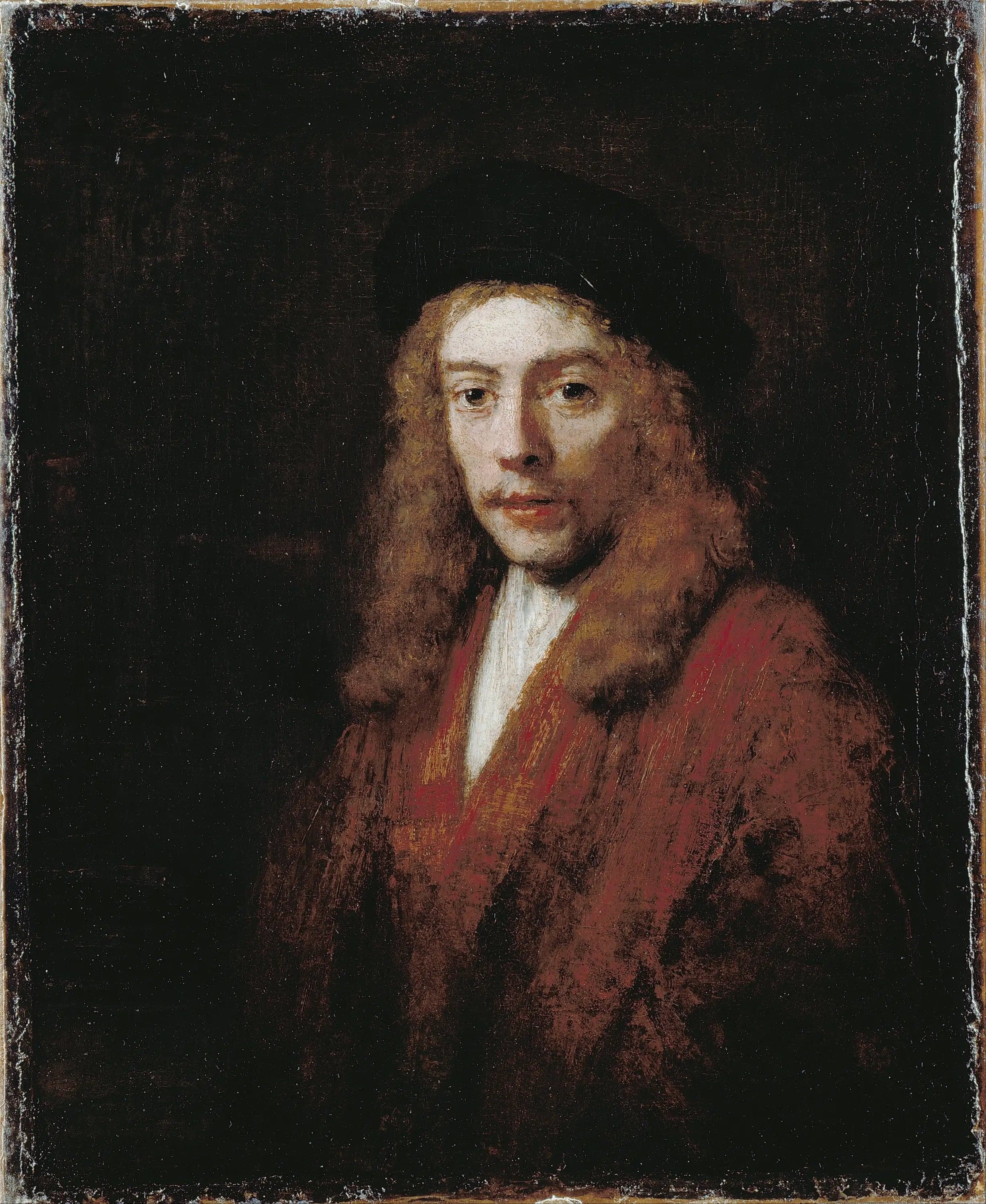
Portrait of a Young Man, Perhaps Titus
- Original dimensions
- 64.2 x 78.6 cm
- Museum
- Dulwich Picture Gallery
- Year
- 1663
Scene depicted
The painting “Portrait of a Young Man, Perhaps Titus” depicts a teenager with a penetrating gaze, frozen in a pose that expresses both youth and early wisdom. Illuminated by subtle plays of light, his face reflects deep introspection, while his luxurious drapery underscores the richness of the era. The composition fits within a classical dynamic, offering a dialogue between the individual and his environment, reinforcing the idea of personal identity through art.
Historical context
Created in 1663, this painting masterfully finds its roots in the rich cultural soil of Amsterdam, at the heart of the United Provinces of the Netherlands. Rembrandt , an iconic figure of the Baroque movement, captured the essence of his time through this painting, a testament to technical mastery and palpable emotion. Currently, this canvas is an integral part of the collections at Dulwich Picture Gallery, offering the public a glimpse into the artistic ingenuity of its creator.
Place in the artist's career
This painting occupies a central position in Rembrandt's career, marking a period of maturity and exceptional mastery. Just before this painting, he created “The Night Watch,” a monumental work , where his chiaroscuro technique sharpens. Afterward, he further explores the intimacy of portraits, with “Saskia de Uylenburgh,” demonstrating a palpable evolution in his humanistic approach.
Anecdote
“Every brushstroke must breathe life,” said Rembrandt , wandering one morning through the cobbled streets of Amsterdam. It is perhaps in this quest for shadows and lights that the idea for his painting came to him, during a fleeting exchange of glances with a young man, who could have been his own son, Titus. This work thus becomes not only a portrait but a fragment of living memory, awakening a strong emotional resonance.