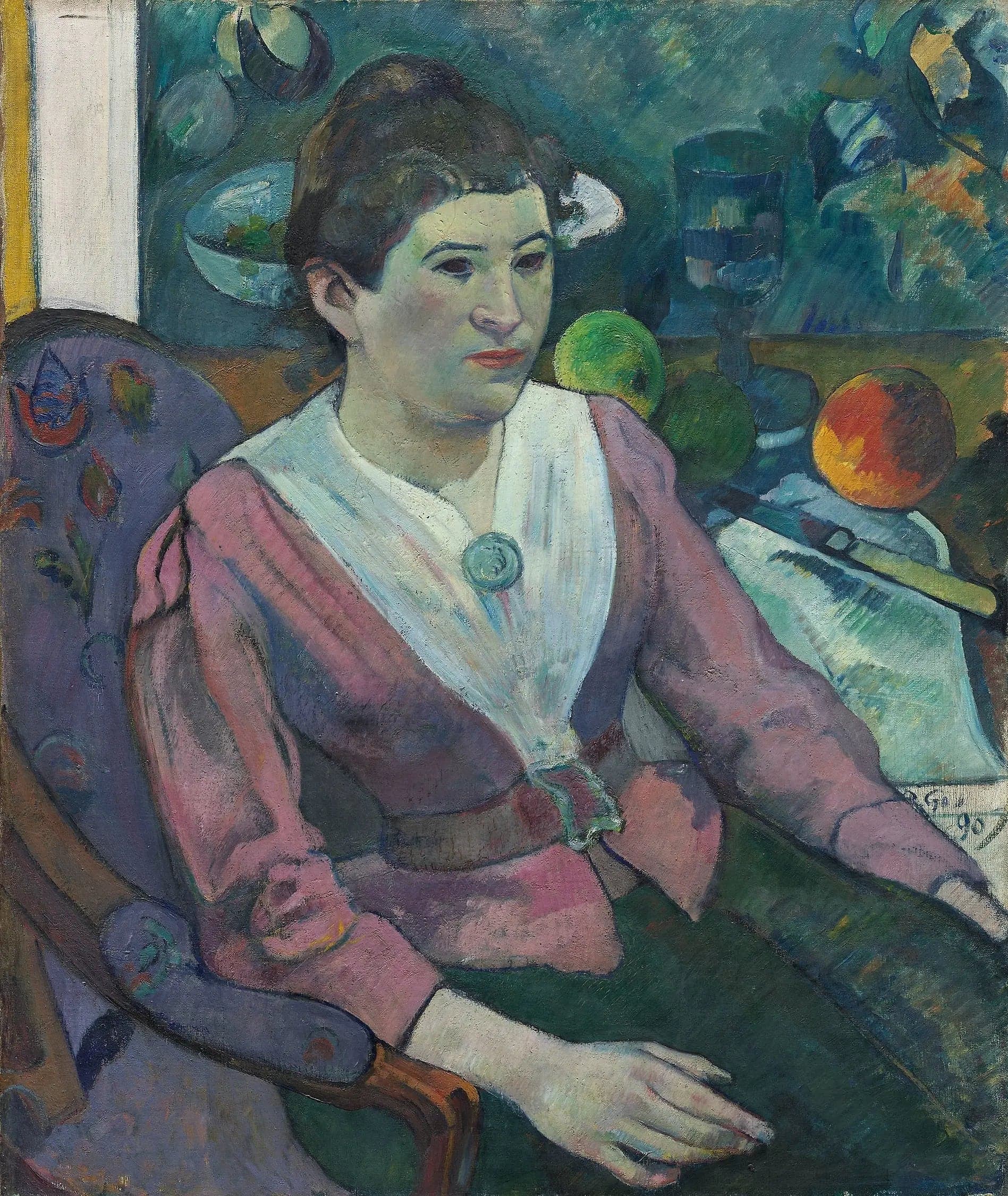
Portrait of a Woman with Cézanne's Still Life
- Original dimensions
- 55 x 65 cm
- Museum
- Art Institute of Chicago
- Year
- 1890
Scene depicted
The charm of the painting lies in its skillful blend of portrait and still life. A graceful woman stands still, surrounded by a lush floral composition that evokes the ephemeral beauty of life. Each element tells a story, thus binding fragments of existence into a unified painting. The canvas becomes a living scene, a reflection of human emotions.
Historical context
Created in 1890, this painting emerges in the Paris of the Impressionists , a vibrant city where avant-garde ideas are born. A member of the Post-Impressionist movement, Gauguin captures here a unique moment, intertwining artistic destinies and the allure of nature, as the bubbling trends of a new art reveal themselves. The painting is currently on display at the Art Institute of Chicago , where its genius continues to enchant visitors.
Place in the artist's career
This intimate portrait marks a period of maturation in Gauguin's career. Far from being a mere technical exercise, it stands alongside other masterpieces, such as “The Twenty-Eight Elements” and “Where Are We Going?”, revealing his journey towards pure emotion. In this painting , the techniques employed already mark the innovative imprint that will characterize his future style.
Anecdote
“Each painting is a dialogue with the human soul,” Gauguin might have said while gazing at the painting we admire. The awakening of inspiration revealed itself during a morning walk in a blooming garden, where flowers and fruits intertwine in a colorful dance. This pictorial work tells an ode to passions, blending sweetness and depth.