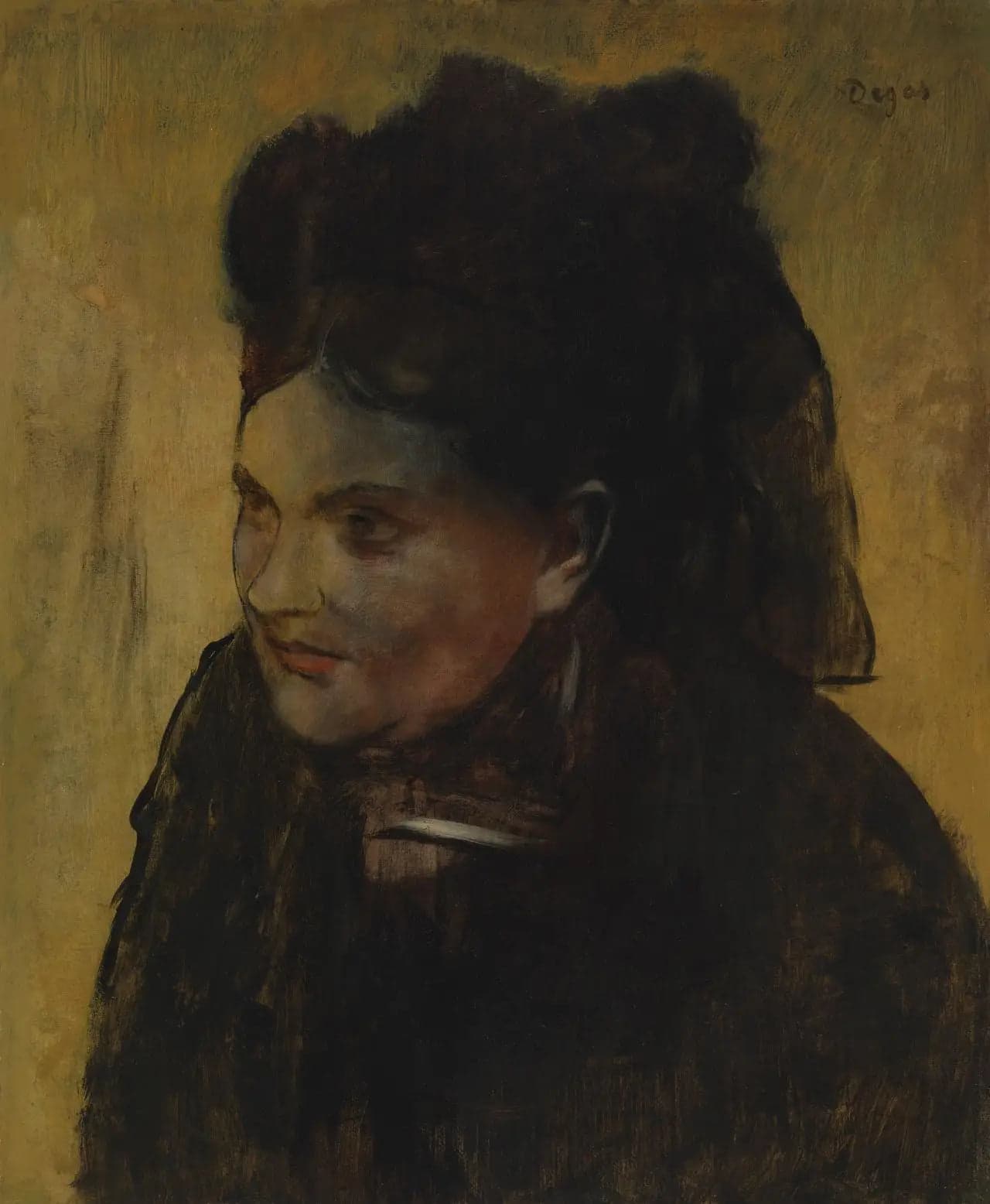
Portrait of a Woman
- Original dimensions
- 33 x 41 cm
- Museum
- Hamburg Kunsthalle
- Year
- 1867
Scene depicted
This painting reveals a woman sitting, enveloped in a spirit of contemplation. Her gaze is fixed into the void, offering a snapshot of vulnerability. The canvas , rich in textures and details, immerses us in her inner world, a reflection on solitude and beauty, combined with the melancholy of the moment. Each shade of color seems to breathe, evoking sincere emotions that touch us deeply.
Historical context
Created in 1867, this painting resides within the Hamburg Kunsthalle . Edgar Degas , a pioneer of the Impressionist movement, captures here a unique intimacy, reflecting a time when art began to free itself from conventions. Portrait of a Woman is part of a period when art started to explore everyday life and human emotions, while anchoring its aesthetics in a dynamic urban context.
Place in the artist's career
Portrait of a Woman represents a crucial step in Edgar Degas's career, marking a transition towards greater expressiveness. It stands alongside other iconic works such as The Ballet Dancer and L'Absinthe, where the artist, through his mastery of movement and emotions, illustrates an unparalleled technical and stylistic development. This painting is a poignant testament to his evolution towards more intimate and emotional compositions.
Anecdote
“Art is meant to be contemplated, it is emotion and the moment that meet,” Degas might have said one spring morning in Paris, inspired by the soft light filtering through the curtains of a café. It is in this atmosphere imbued with poetry that the idea for this masterpiece emerged, where each brushstroke invites a deeper exploration of the feminine psyche.