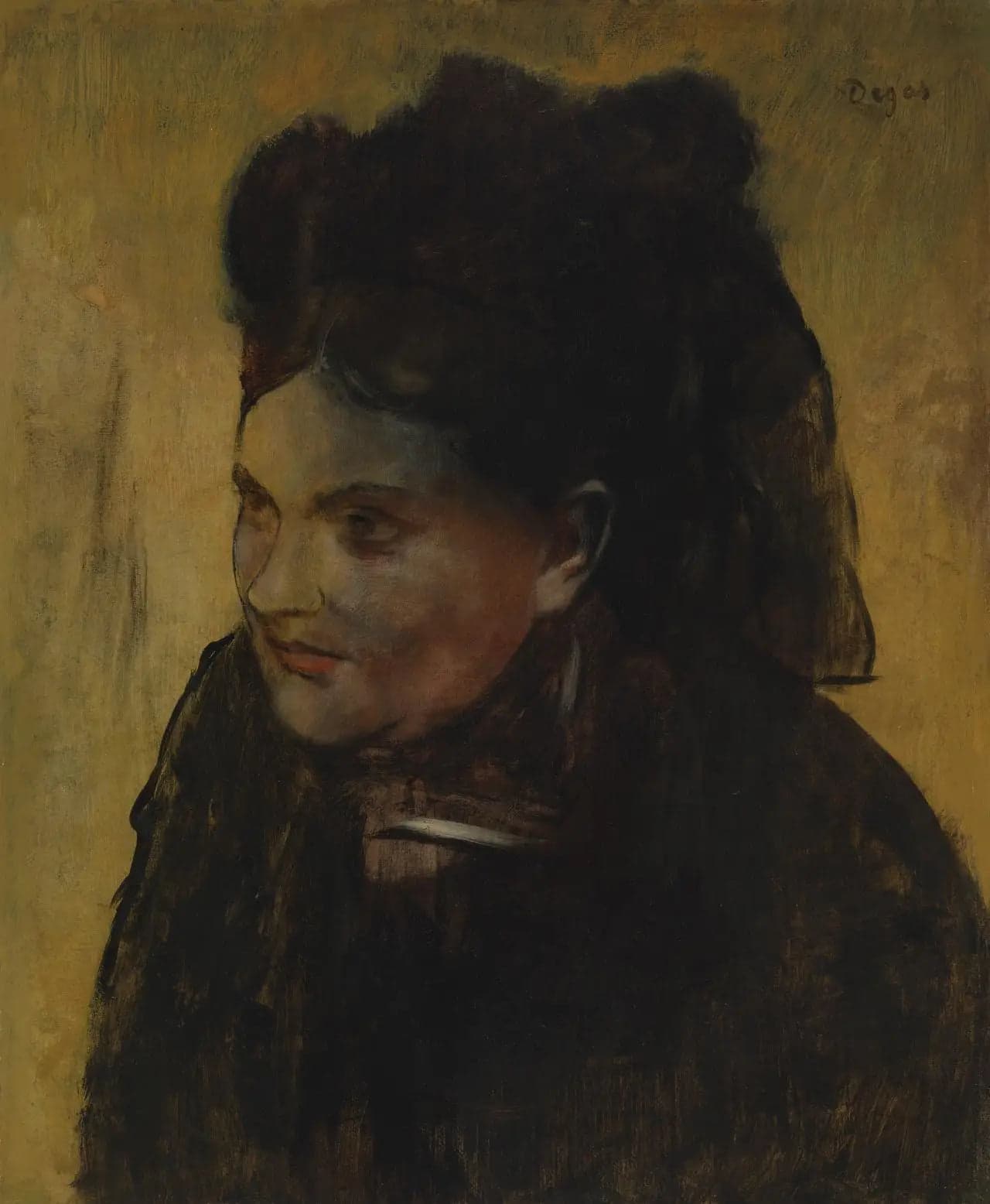
Portrait of a Woman
- Original dimensions
- 38.2 x 46.3 cm
- Museum
- National Gallery of Victoria
Scene depicted
In this masterpiece, the canvas reveals a woman of a different radiance, seated in a soft and reflective ambiance. The mysterious gaze, the light gesture, every element of this composition contributes to creating a personal story that resonates with the viewer. It is an intimate and subjective vision that Degas wishes to share, inviting us to dive into an atmosphere that is both serene and charged with emotion.
Historical context
Created in 1891, this painting , a subtle manifestation of Impressionism , immerses us in the artistic effervescence of Paris. Edgar Degas , undisputed master of the movement, captures here the essence of a woman, both fragile and strong, at the heart of a city vibrating with the lights and sounds of a bygone era. The canvas , now preserved at the National Gallery of Victoria in Melbourne, is an invitation to explore a moment frozen in time, immortalized on a canvas of 38.2 x 46.3 cm.
Place in the artist's career
This painting represents a turning point in Degas's career, at the dawn of his artistic maturity. The exploration of psychology and human movement brings him closer to works like The Fourteen-Year-Old Dancer and The Dancers on Stage , where emotional intensity and technical meticulousness meet in a unique pictorial dance.
Anecdote
“I have always wanted to capture what is fleeting. Every color, every shape, every gaze speaks to me of a lost emotion.” This reflection could easily convey the essence of Portrait of a Woman . Imagine Degas, one spring morning, wandering through the cobbled streets of Paris, where a simple glance at the face of a passerby inspires him to capture the ephemeral beauty of life.