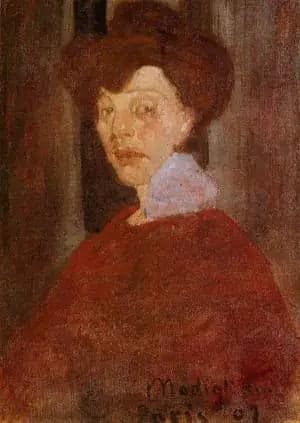
Portrait of a Woman
- Original dimensions
- 45.4 x 55.9 cm
- Museum
- Art Institute of Chicago
- Year
- 1917
Scene depicted
The canvas “Portrait of a Woman” depicts a woman with an introspective gaze, her elongated and stylized features, a distinctive characteristic of Modigliani's work. The composition, both delicate and powerful, evokes a timeless mystique, reproducing the essence of feminine beauty. This painting reveals the soul of the model, inscribing her image in the annals of art, transforming a simple figure into a human reflection.
Historical context
Created in the vibrant Paris of the 1900s, this iconic masterpiece embodies the essence of the modernist movement. At a time when art is radically transforming, Portrait of a Woman reveals the boldness and originality of Amedeo Modigliani , a passionate artist who, through his works, touches the heart of human emotion. Today preserved at the Art Institute of Chicago , this painting testifies to an era rich in creativity and innovation.
Place in the artist's career
This painting , created in 1917, is situated at a turning point in Modigliani's career, witnessing a growing pictorial mastery. Following earlier works such as “The Woman in Blue” and “Reclining Nude,” Portrait of a Woman illustrates an artistic maturation where emotional depth and the quest for aesthetic ideal converge with talent and sensitivity.
Anecdote
In recalling the inspiration behind this painting , Modigliani stated: “Art must not only represent what one sees, but also what one feels.” The flash of genius struck in an alley in Montparnasse, bathed in the soft light of dawn, where a face encountered awakened a muse. It is this pure emotion that animates every brushstroke of Modigliani's masterpiece .