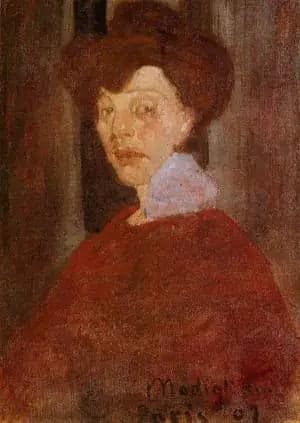
Portrait of a Woman
- Original dimensions
- 33.2 x 46.1 cm
- Museum
- Not specified
- Year
- 1907
Scene depicted
The painting “Portrait of a Woman” depicts a serene woman, eyes closed, immersed in silent contemplation. The delicacy of her features and the elegance of her posture rise above the concerns of the world. Modigliani, with his characteristic technique, manages to capture an ethereal essence, an inner light that resonates through the canvas like an intimate melody.
Historical context
Created in 1907, during the artistic effervescence of the early 20th century, this painting is the result of experimentation within the modern movement. Modigliani, based in Paris, a leading city of the avant-gardes, draws his inspiration from the beauty of forms and faces, thus transcending classical limits. This canvas , now recognized as a milestone of his work, testifies to a time when art liberates itself from conventions, blurry and vibrant.
Place in the artist's career
This canvas represents a crucial step in Modigliani's career, marking his emergence on the artistic scene. Between the canvas “The Young Girl in Blue” and the famous “Reclining Nude,” “Portrait of a Woman” serves as a bridge, revealing the emotional depth and stylistic evolution of the artist throughout his short but prolific career.
Anecdote
It is said that Modigliani once confided: “I do not seek to paint what I see, but what I feel.” It was on a sunny afternoon, in a small courtyard in Montparnasse, that he crossed the gaze of a young woman. This fleeting moment would inspire his masterpiece, “Portrait of a Woman,” where each brushstroke evokes a poignant softness and melancholy.