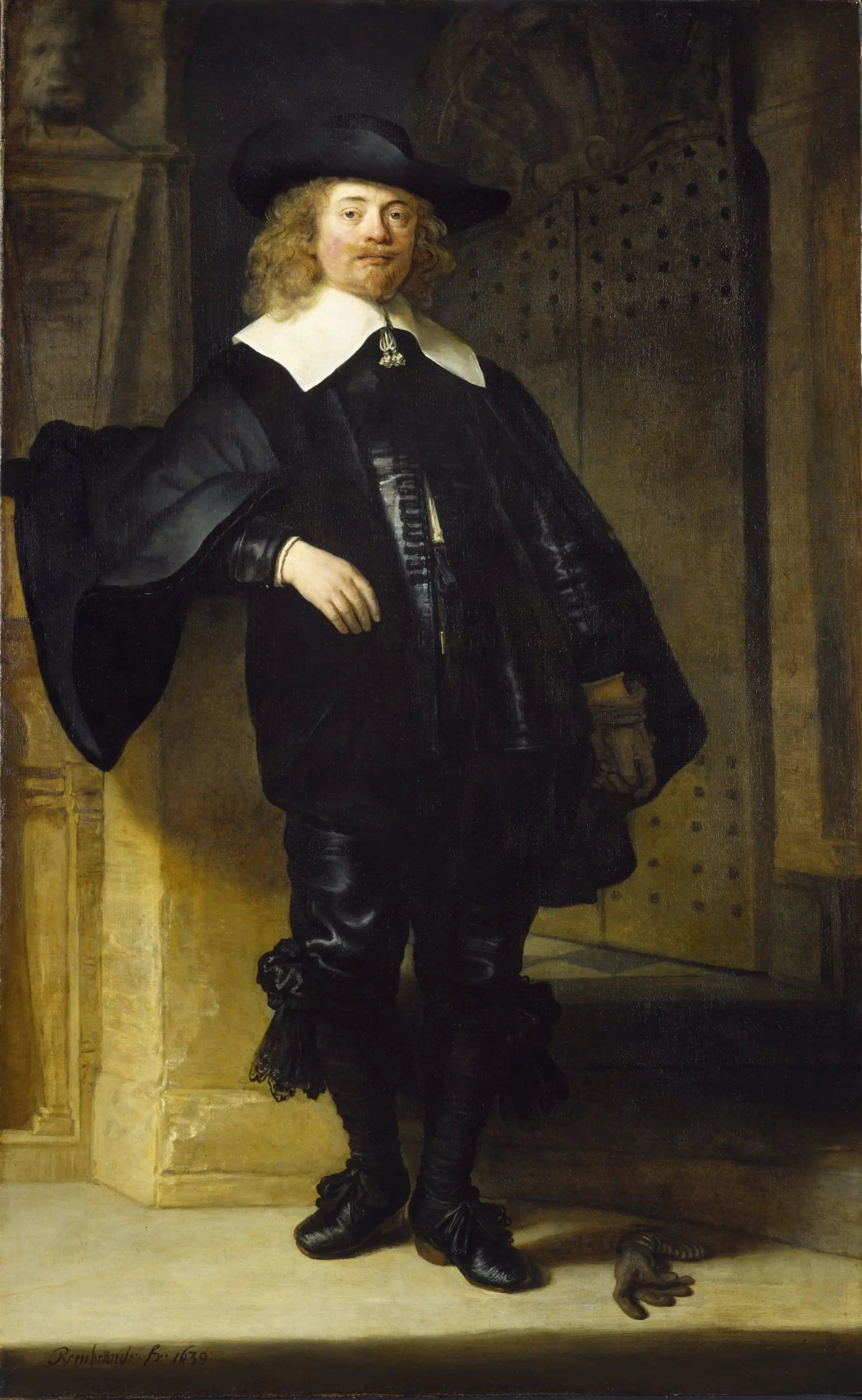
Portrait of a standing man, perhaps Andries de Graeff
- Original dimensions
- 124.2 x 200 cm
- Museum
- Gemäldegalerie Alte Meister
- Year
- 1639
Scene depicted
This canvas powerfully illustrates a man, possibly Andries de Graeff, standing confidently, wrapped in dark drapery, while a golden light subtly caresses his face and shoulders. Rembrandt reveals not only his talent as a portraitist but also his ability to convey complex emotions through the delicacy of shades and the reality of expressions.
Historical context
Created in 1639, in the vibrant streets of Amsterdam, this painting is emblematic of the exceptional Baroque movement. Through the interplay of light and shadow, Rembrandt captures the very essence of his time, revealing the psychological depth of human figures. This canvas , currently displayed at the famous Gemäldegalerie Alte Meister museum, evokes a cultural panorama where artistic innovation and technical mastery meet. Its impressive dimensions of 124.2 x 200 cm make it an unmissable masterpiece.
Place in the artist's career
The portrait of Andries de Graeff stands at the crossroads of styles during Rembrandt 's career, reflecting his artistic evolution. Both an emblematic achievement and a pivotal moment, this painting stands alongside his other major works such as “The Night Watch” and “The Return of the Prodigal Son,” illustrating the mastery of light and the richness of emotions that characterize his work.
Anecdote
“Every face tells a story; I strive to hear it before I paint it.” Rembrandt , inspired by a gentle April morning, stood in his studio, observing faces in the bustling alleys of Amsterdam. This fleeting moment of encounter, imbued with light, infuses this pictorial work with an evocative power that captivates the viewer.