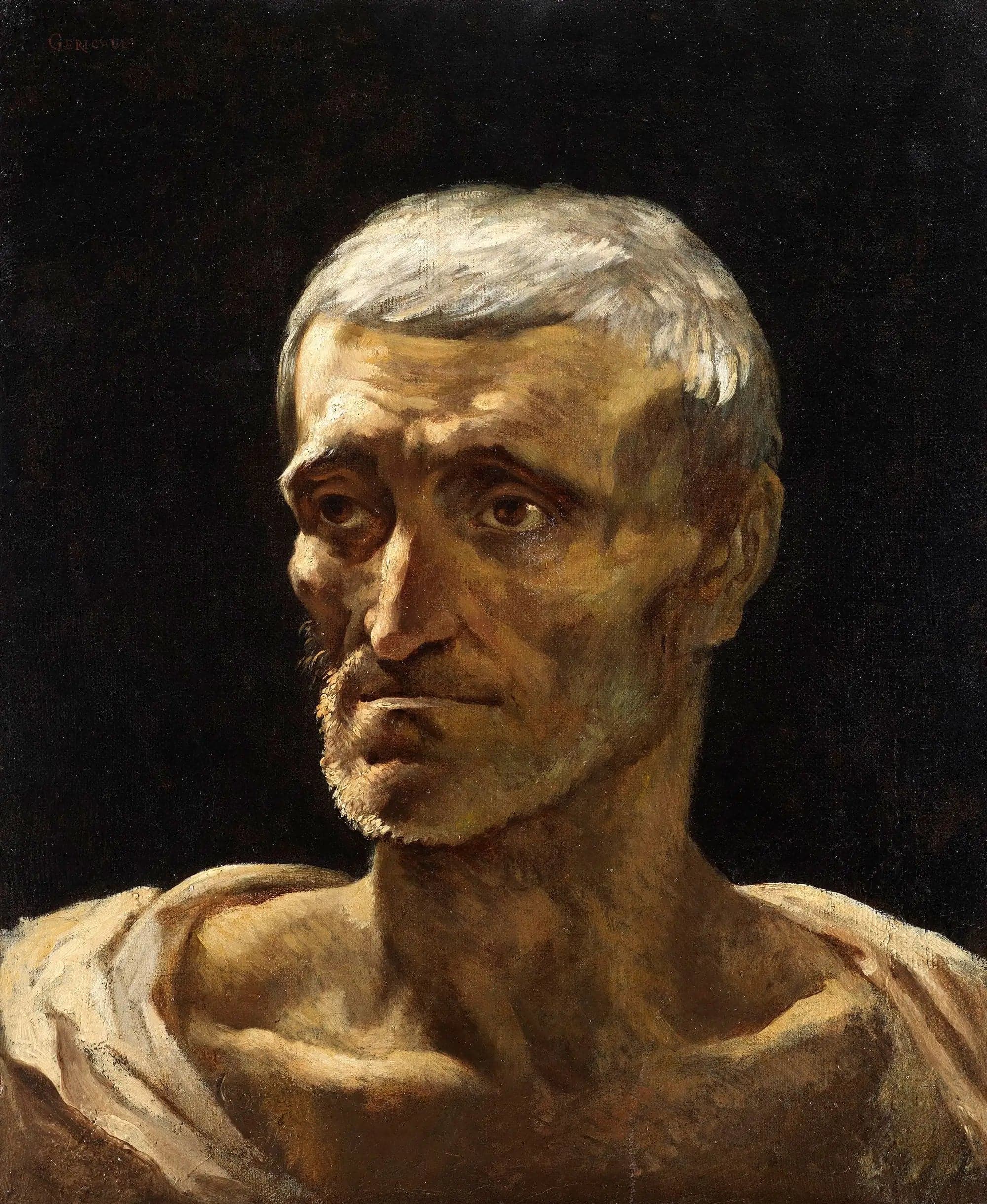
Portrait of a Shipwrecked Man
- Original dimensions
- 37.3 x 46.5 cm
- Museum
- Museum of Fine Arts and Archaeology of Besançon
- Year
- 1818
Scene depicted
The painting “Portrait of a Shipwrecked Man” reveals a lost man, who survived a disastrous maritime ordeal. The empty and poignant gaze of this character evokes stories of survival and despair. This pictorial work emphasizes the importance of human vulnerability in the face of the untamed forces of nature, revealing the depth of the human condition in the wake of the storm.
Historical context
Created in 1818, this canvas emblematic of romanticism is rooted in a rich historical context, evolving in the heart of post-revolutionary France. The painting , which currently finds refuge in the Museum of Fine Arts and Archaeology of Besançon, testifies to the quest for graphic authenticity of an artist in full exploration of human emotions. The dimensions of this work, measuring 37.3 by 46.5 centimeters, enhance its presence on the artistic scene.
Place in the artist's career
“Portrait of a Shipwrecked Man” marks a crucial milestone in Géricault's career, solidifying his status as a master of the romantic movement. Compared to other works such as “ The Raft of the Medusa ” and “ Officer of Chasseurs ”, this painting demonstrates a marked technical evolution, highlighting his incessant need to explore the deepest emotions.
Anecdote
“The truth is found only in the power of emotions captured on the canvas.” These words resonate strongly as Géricault draws inspiration from the shipwrecked of Odessa on a misty morning. It is in this intensity of light on his face, blending sorrow and hope, that the very soul of his masterpiece takes shape, irrigating the scene with tragic humanity.