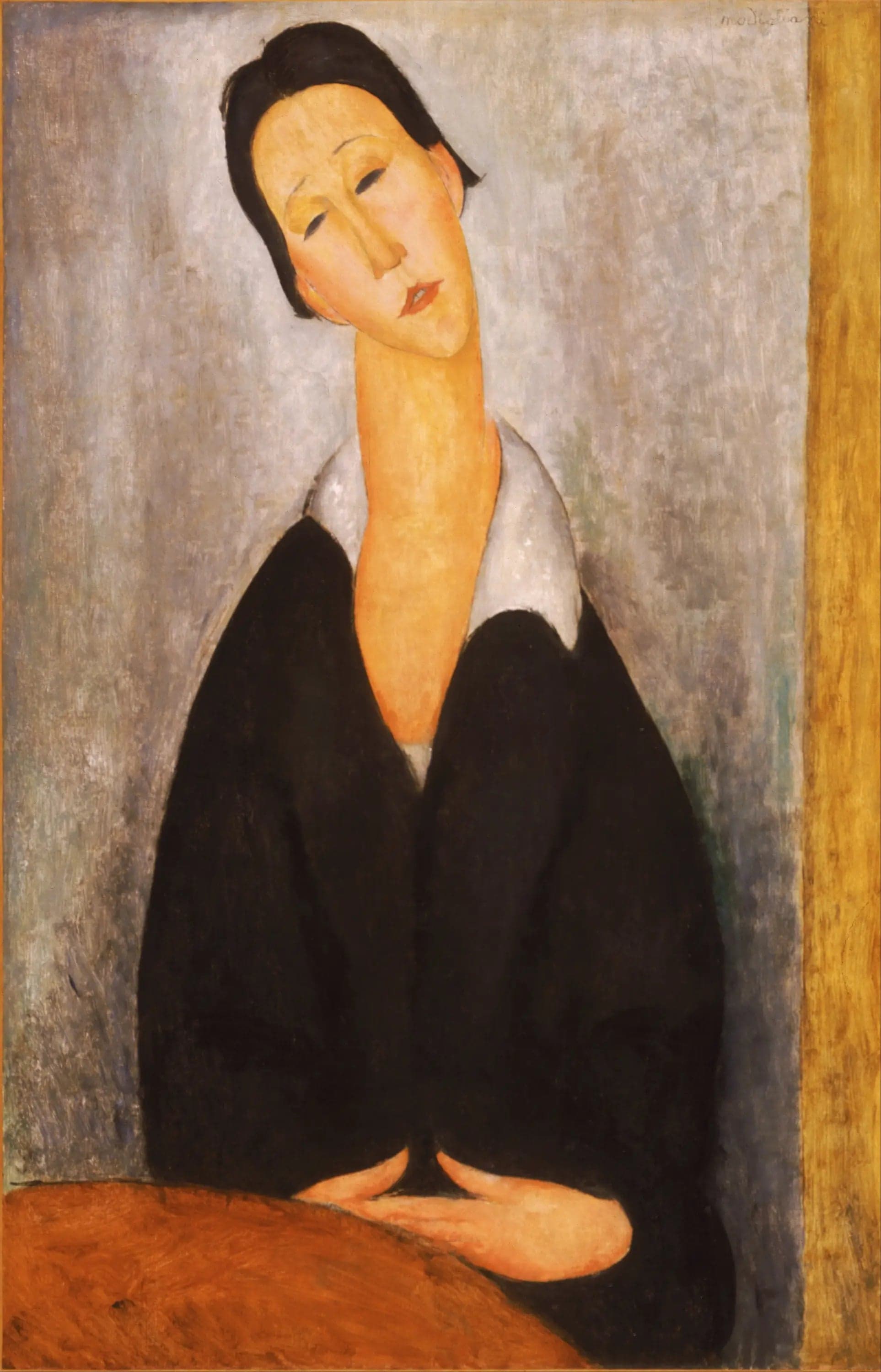
Portrait of a Polish Woman
- Original dimensions
- 648.46 x 1003.81 cm
- Museum
- Philadelphia Museum of Art
- Year
- 1919
Scene depicted
In the painting “Portrait of a Polish Woman,” Modigliani captures the essence of a woman with a serene demeanor, revealing her intimacy with finesse. Her posture, slightly bent, and her distant gaze evoke both delicacy and inner strength. The composition, characterized by elongated lines and a subtle play of colors, testifies to the artist's love for feminine beauty and the expression of human emotions.
Historical context
Created in 1919, during a period marked by the resonances of artistic Avant-gardes in a rapidly changing Europe, the painting titled Portrait of a Polish Woman is part of Modigliani's work, an emblematic artist of the surrealist movement. Currently, this composition is preserved at the Philadelphia Museum of Art , a cultural treasure of the American city in the heart of Pennsylvania. Its majestic dimensions of 648.46 x 1003.81 cm add to its poignant presence.
Place in the artist's career
This painting represents a pivotal moment in Modigliani's career, marking the maturity of his style. Alongside other works such as Reclining Nude and Portrait of Mrs. Hector Fonceca , “Portrait of a Polish Woman” reflects the technical and emotional evolution of the artist, his relentless pursuit of beauty and expression.
Anecdote
Modigliani is said to have once declared: “Every face has a story to tell, every gaze a melody.” It was on a morning bathed in autumn light, in a bustling alley of Montmartre, that he is said to have crossed the face of a woman, a fleeting silhouette that inspired him deeply. This fleeting moment left a marked imprint in the painting , infusing the canvas with humanity and the depth of emotions.