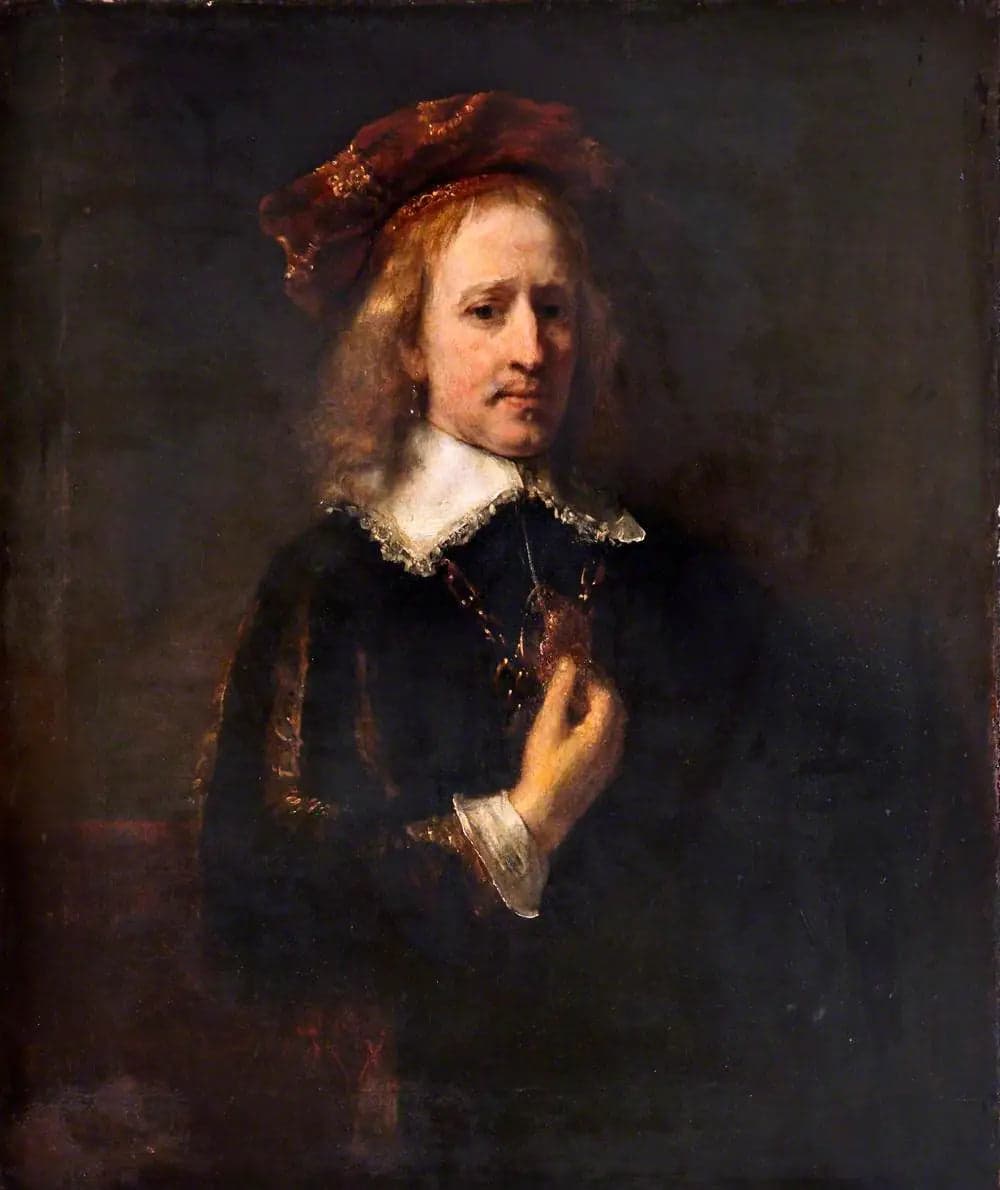
Portrait of a Man
- Original dimensions
- 45.1 x 54.9 cm
- Museum
- Brodsworth Hall
- Year
- 1860
Scene depicted
This pictorial work illustrates a man whose gaze, imbued with wisdom and mystery, captivates us. The dark background highlights the illuminated face, thus accentuating the characteristic features of the individual, while inviting the viewer to dive into his thoughts, making this painting a window into the human soul.
Historical context
The painting "Portrait of a Man" was created during a significant period of the Dutch Golden Age in the 19th century. Its roots lie in the city of Leiden, where Rembrandt , a prominent master of baroque , managed to capture human essence with remarkable intensity. This masterpiece, displayed at the Brodsworth Hall museum, fascinates with its composition and play of light, embodying the spirit of an era rich in creativity and artistic innovation.
Place in the artist's career
"Portrait of a Man" is situated at an important turning point in Rembrandt's career, reflecting his growing mastery of intimate portraits. Alongside other masterpieces such as "The Night Watch" and "The Syndics of the Drapers' Guild," this painting highlights his technical evolution, which refines with experience while preserving the emotional power of his art.
Anecdote
“Art never reveals everything, but it suggests what cannot be expressed in words.” Rembrandt is said to have declared this one sunny morning while observing his model through the soft light of a window. This melancholy is found in every brushstroke of his "Portrait of a Man," where the soul of the character seems to express itself while remaining enigmatic.