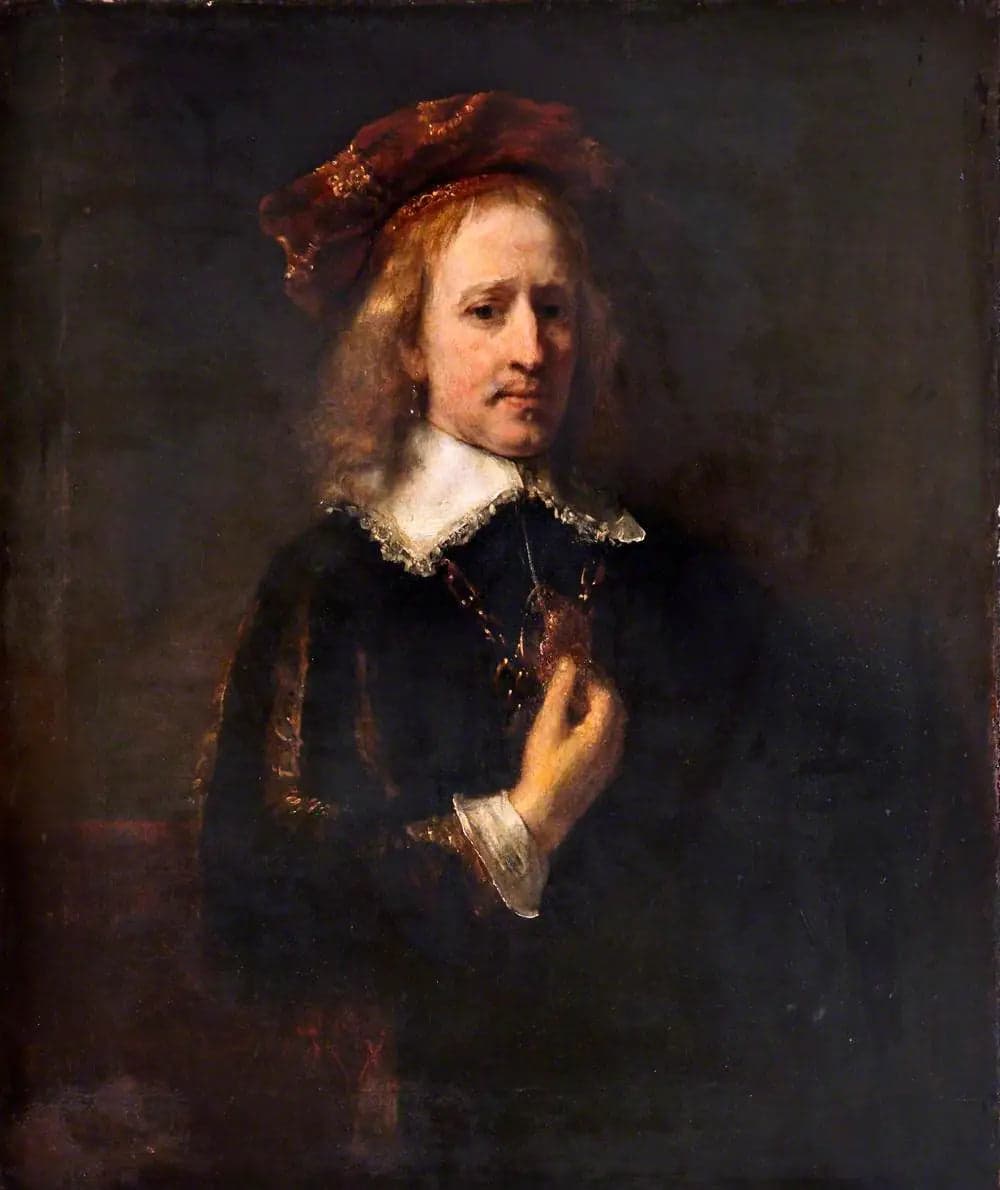
Portrait of a Man
- Original dimensions
- 64.5 x 83.5 cm
- Museum
- Metropolitan Museum of Art
- Year
- 1650
Scene depicted
The painting “Portrait d'homme” reveals a man's head, immersed in deep thought, his eyes scrutinizing us while revealing complex emotions. The painting , with striking realism , suggests a wordless narrative, leaving the viewer the freedom to interpret the character's thoughts. The atmosphere, laden with mystery, invites silent contemplation.
Historical context
This canvas emblematic, created in 1650, emerges in the heart of Amsterdam, a thriving city in Holland during the Dutch Golden Age. This masterpiece belongs to the baroque movement, characterized by its expressiveness and striking realism . The painting , now displayed at the Metropolitan Museum of Art , remains an essential reference for art lovers. With impressive dimensions of 64.5 x 83.5 cm, it captures the emotional intensity of a moment frozen in time.
Place in the artist's career
This masterpiece is part of a flourishing period in Rembrandt 's career, marking a turning point towards greater psychological depth. Compared to works such as “The Anatomy Lesson of Dr. Tulp” and “The Night Watch,” “Portrait d'homme” illustrates the evolution of his style, where intimacy and introspection become priorities.
Anecdote
“I always seek to capture the soul of a man through my brush.” These words, spoken on a misty morning, resonate like a promise. It is in an alley in Amsterdam, illuminated by a soft morning light, that Rembrandt drew inspiration for this painting , where each brushstroke tells an intimate story.