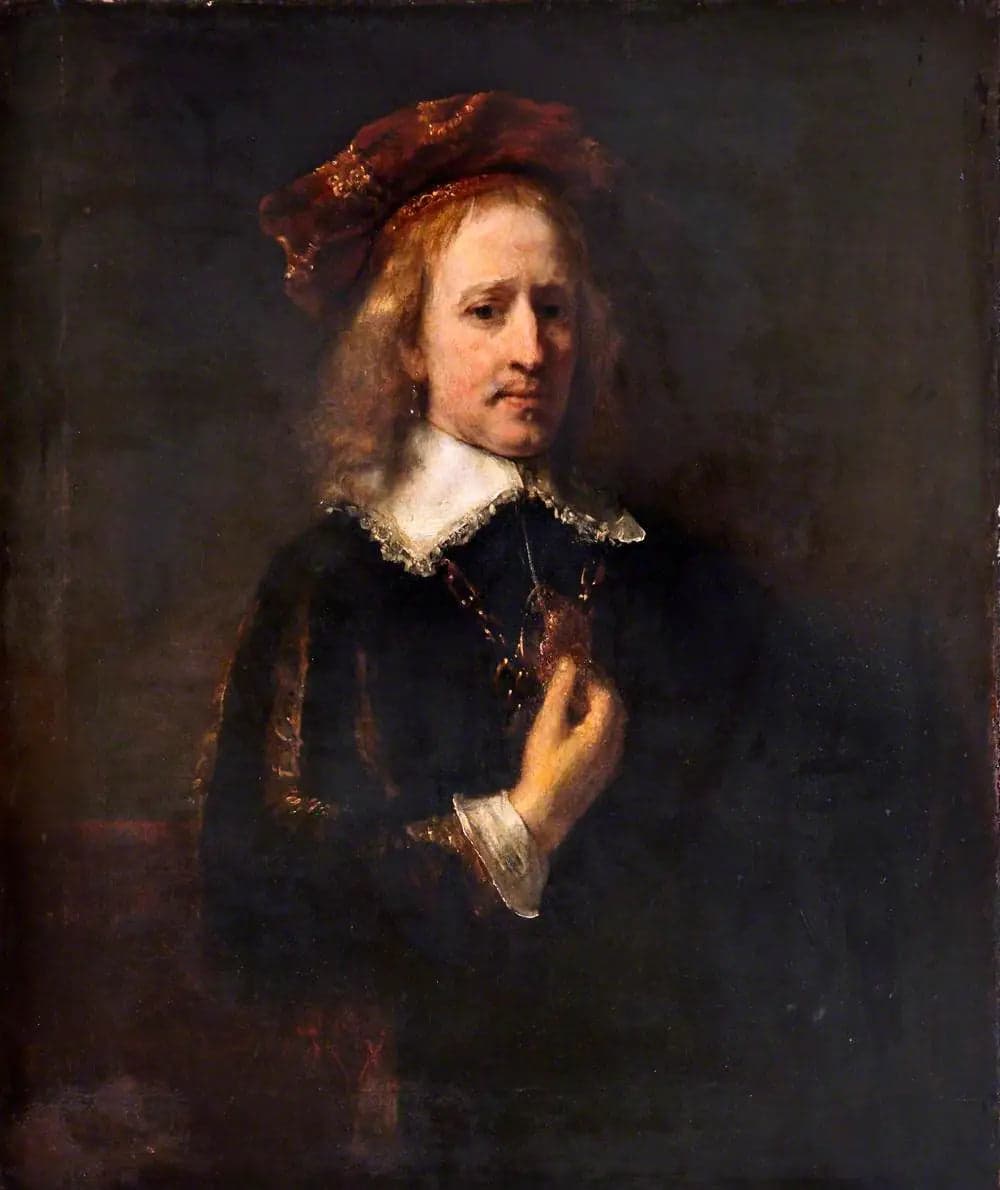
Portrait of a Man
- Original dimensions
- 47.3 x 63.5 cm
- Museum
- Herzog Anton Ulrich Museum
- Year
- 1632
Scene depicted
This painting depicts a man whose piercing gaze challenges observers. With a noble demeanor, his expression reveals a deep, almost intimate reflection. This portrait, created according to the principles of realism , testifies to Rembrandt 's ability to immortalize human emotion beyond mere shaping of form, inviting us to enter a universe of silent thoughts and unfinished narratives.
Historical context
Created in 1632, this painting is located in Brunswick, a city rich in art and culture, in the heart of Germany. Rembrandt , emblem of the baroque movement, captured the essence of portraiture at that time, where painting becomes the mirror of an introspective and complex humanity. Currently exhibited at the Herzog Anton Ulrich Museum, this painting of 47.3 x 63.5 cm embodies the soul of an era where technical mastery and emotion intertwine in every brushstroke.
Place in the artist's career
Portrait d’homme is part of a crucial period in Rembrandt 's career, marking a transition towards a more personal and psychological expression in his paintings . Alongside The Night Watch and The Syndics of the Dutch East India Company, this pictorial work reveals his journey towards exploring the human soul, oscillating between realism and introspection.
Anecdote
“Every face is a contained story, a captivating light in the shadow of days.” On a spring morning in Holland, an uncertain face encountered in an alley inspired Rembrandt . It is this fleeting moment that brought to life the evocative power of this masterpiece , making it resonate with palpable humanity.