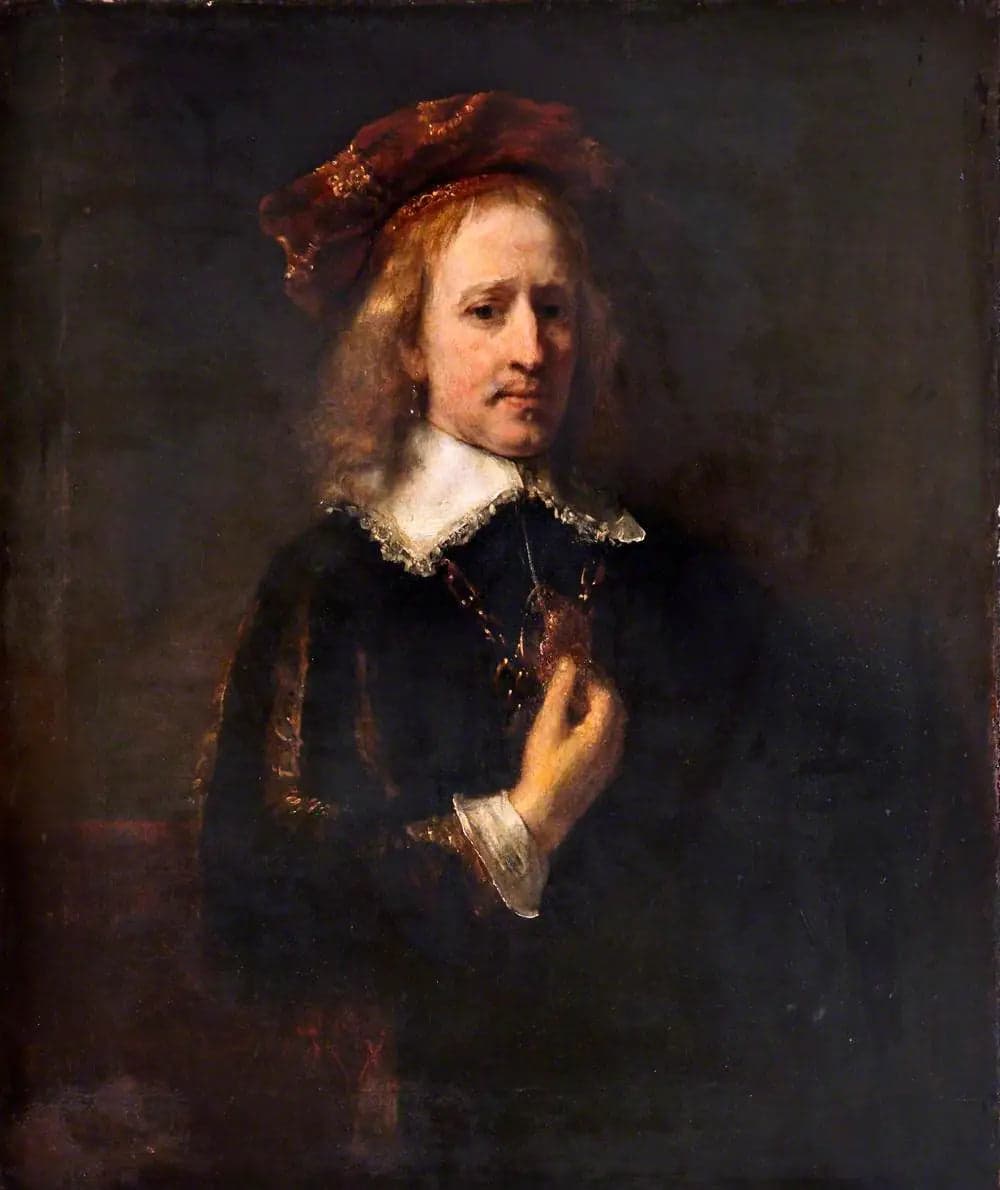
Portrait of a Man
- Original dimensions
- 52.1 x 75.6 cm
- Museum
- Metropolitan Museum of Art
- Year
- 1632
Scene depicted
The painting “Portrait d'homme” stands out for its striking character. The subject, a mysterious man, is captured in a moment of reflection. The play of shadows and light envelops his face, revealing a rich and complex inner life. Rembrandt succeeds in immortalizing not just a face, but also a soul, each brushstroke vibrant with sensitivity.
Historical context
Created in 1632, in the vibrant city of Amsterdam, this painting is at the heart of the Dutch Golden Age, an artistic movement recognized for its richness and complexity. Today, this canvas proudly resides at the Metropolitan Museum of Art , where it continues to move visitors with its impressive dimensions.
Place in the artist's career
This painting marks a major milestone in the career of Rembrandt , signaling a shift towards a more introspective style. In parallel, the works “The Night Watch” and “Self-Portrait” testify to his evolution, where this masterpiece becomes the pivot between his technical exploration and his deep emotional engagement.
Anecdote
“Every face tells a story,” said Rembrandt , immersed in the light of a peaceful morning. It was at that moment, crossing the gaze of a stranger in the streets of Amsterdam, that he found inspiration for his masterpiece . The intensity of this painting lies in the depth of that fleeting moment, rendered eternal.