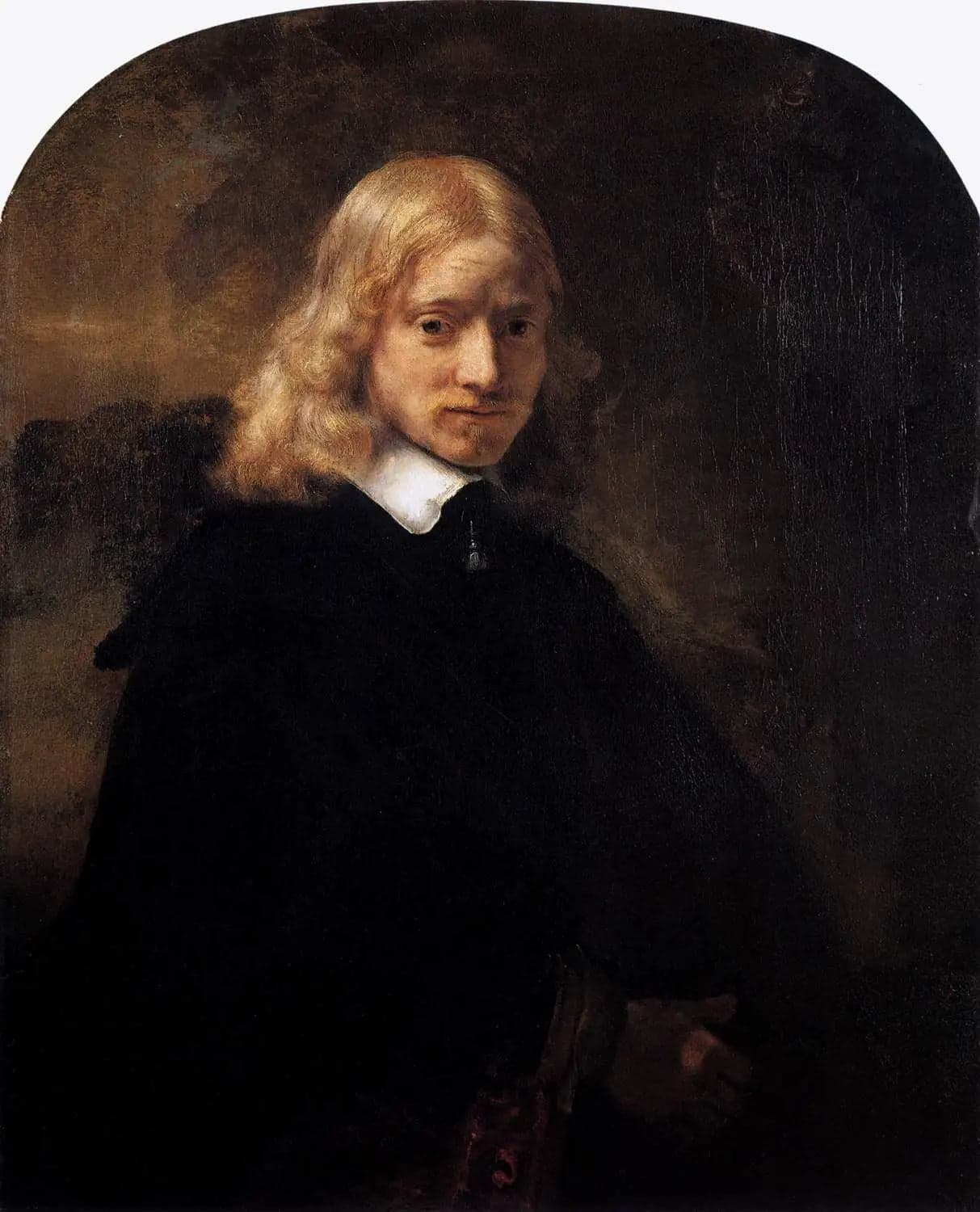
Portrait of a man, perhaps Pieter Six
- Original dimensions
- 73.5 x 92.5 cm
- Museum
- Buscot Park
- Year
- 1652
Scene depicted
This painting fascinates by depicting a man carrying stories, reinforcing the power of the portrait as a genre. His deep and contemplative gaze draws the eye and evokes questions about his life, status, and thoughts. Beyond a simple representation, Rembrandt invites us to dive into the very essence of humanity and to contemplate the subtly suggested emotions on this painting .
Historical context
Created in 1652, at the height of the Dutch golden age, this canvas embodies the virtuosity of the master Rembrandt . Located at Buscot Park, this painting transports us to the narrow streets of Amsterdam, where realism and introspection blend with every brushstroke. The painting bears witness to a time when light and shadow become characters in their own right, offering an intriguing and fascinating atmosphere.
Place in the artist's career
The Portrait of a Man, Perhaps Pieter Six is a milestone in Rembrandt's career, marking this period when he excels in the play of light and shadow. Alongside other masters such as “The Night Watch” and “Judith and Holofernes,” this painting illustrates the maturation of his style, from raw realism to touching introspection.
Anecdote
“Every face tells a story, you just have to listen” could have been said by Rembrandt while contemplating the faces of the crowd in Amsterdam. Inspired by a gentle April morning, he might have encountered a man whose eyes, filled with promises and mysteries, prompted him to immortalize his spirit on the canvas . This moment of grace is encapsulated in every detail of this pictorial work .