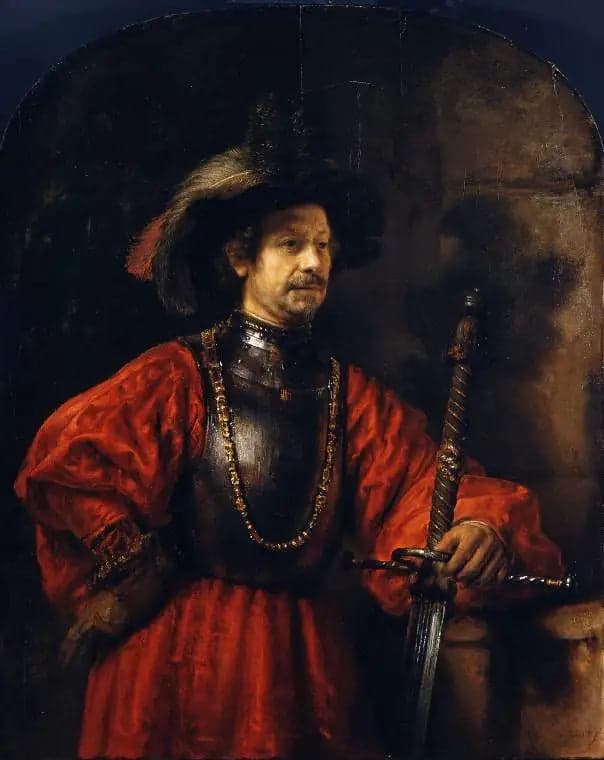
Portrait of a Man in Military Uniform
- Original dimensions
- 104 x 128 cm
- Museum
- Fitzwilliam Museum
- Year
- 1650
Scene depicted
In this pictorial work , a man stands, majestic, dressed in a military costume that testifies to his rank and merit. The intense gaze of the character seems to pierce the canvas, capturing the soul of the viewer and plunging them into deep introspection. Every detail, from the pleats of the uniform to the light caressing his face, reveals an untold story that invites exploration.
Historical context
Created in 1650, this painting embodies the artistic genius of Rembrandt , born in Leiden, Netherlands. This canvas is part of the Baroque movement, a period marked by the play of light and the expressiveness of emotions. Currently, this painting is displayed at the Fitzwilliam Museum in Cambridge, where it continues to inspire visitors with its impressive dimensions of 104 x 128 cm.
Place in the artist's career
This painting , created during a period of artistic maturation for Rembrandt , illustrates a turning point in his career. Alongside The Night Watch and The Anatomy Lesson of Dr. Tulp, Portrait of a Man in Military Costume demonstrates his skill in capturing the complexity of human emotions, while marking an evolution in the depth of details and play of light.
Anecdote
“Light is the soul of the canvas , the heart of the subject.” This quote, inspired by the vision of Rembrandt , echoes the moment he captured the austere face of a man in military costume, one morning in the soft light of an Amsterdam spring. This painting is much more than a simple portrait; it is a reflection on humanity, a palpable breath of emotion that emerges from the composition .