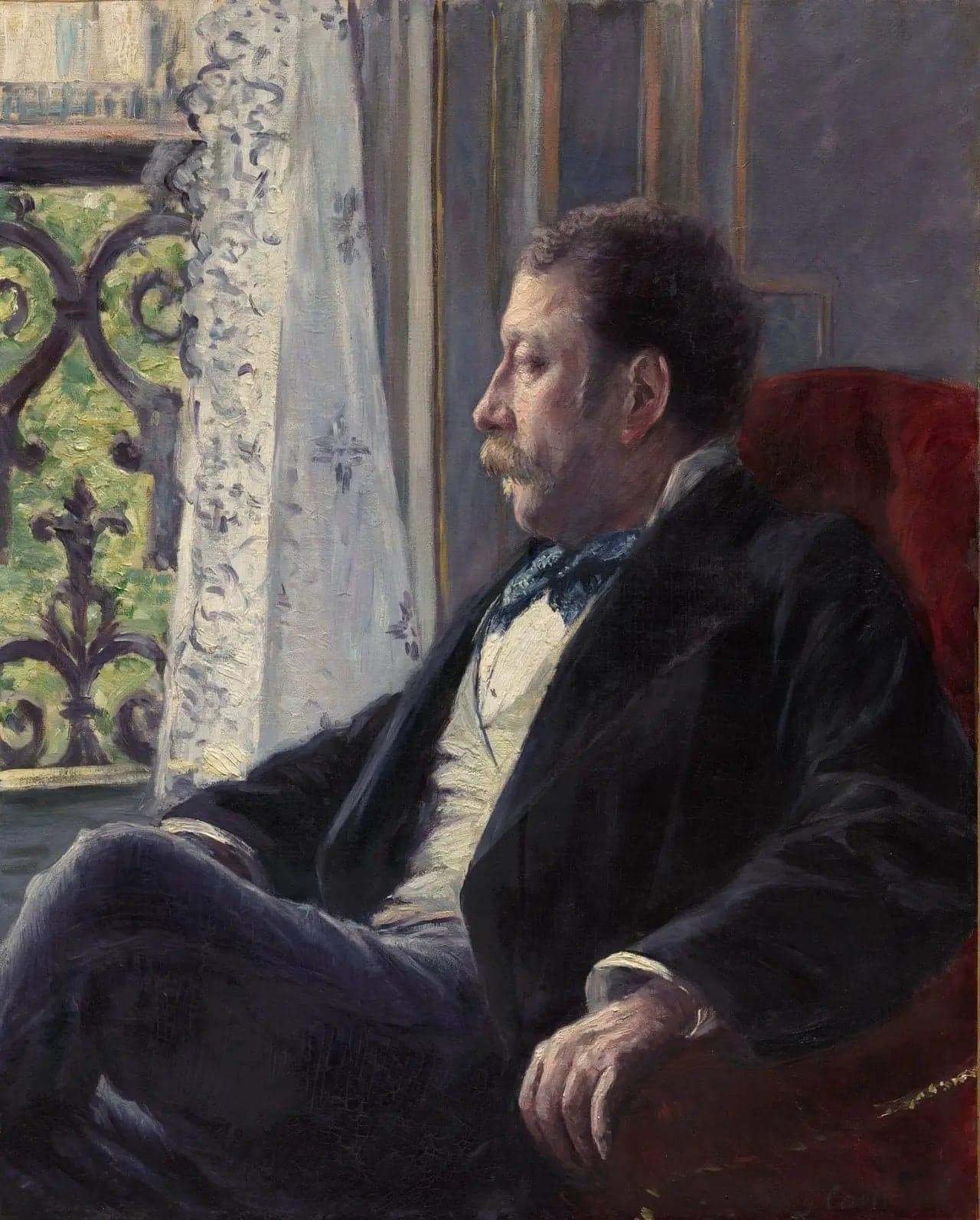
Portrait of a Man
- Original dimensions
- 38.1 x 45.7 cm
- Museum
- Not specified
- Year
- 1881
Scene depicted
This pictorial work immerses us in Caillebotte's particular universe, where every detail matters. The canvas captures a moment of reflection, a pause in time, on the face of a man who seems to contemplate his surroundings. This moment is imbued with nuance and depth, interpellating the viewer in a silent melody of shades and lights.
Historical context
Created in 1881, this painting is emblematic of the artistic effervescence of Paris, cradled by the Impressionist movement. At the heart of the Belle Époque, it fits into a cultural framework where artists explore new ways of seeing and representing the world. Although the current location of this canvas is not specified, its artistic legacy continues to shine through the ages.
Place in the artist's career
Positioned at the peak of his creativity, Portrait d'homme represents an important milestone in Caillebotte's career. Alongside Les Raboteurs de parquet and Le Pont de l’Europe , these works reveal a stylistic evolution from an admiration of peasants to a fascination with urban modernity.
Anecdote
"Art is a passion, a brilliant illumination of the everyday." This quote could very well summarize the moment when Caillebotte, perhaps one bright morning, leaned over the face of a man, thus capturing an atmosphere that is both intimate and universal. The masterpiece that is Portrait d'homme still vibrates with the emotions of a fleeting encounter.