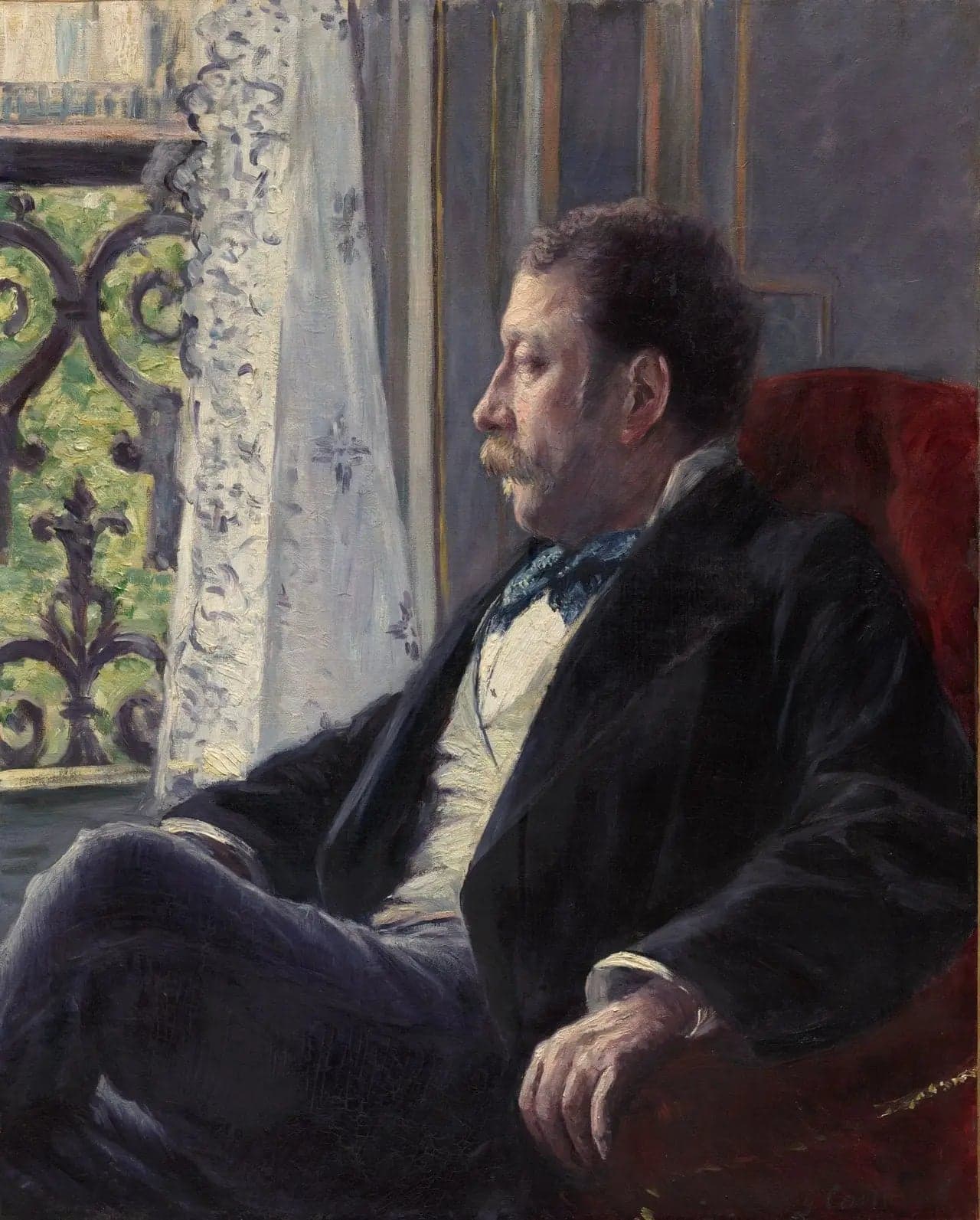
Portrait of a Man
- Original dimensions
- 65.6 x 81.3 cm
- Museum
- Cleveland Museum of Art
- Year
- 1880
Scene depicted
This canvas , Portrait d'un homme , highlights a character whose mysterious expression captivates the observer. The composition depicts a man, carefully dressed, weaving a silent dialogue with the world around him, thus raising questions about his identity and personal history. The presence of this protagonist, in harmony with a dark background, invites contemplation of the unspoken.
Historical context
The painting titled Portrait d'un homme emerged in the heart of France at the end of the 19th century, a pivotal period of the Impressionist movement. Creating this canvas in 1880 was a thoughtful creative act, at a time when Gustave Caillebotte was shaping his legacy as an artist. Today, this pictorial work is carefully preserved at the Cleveland Museum of Art , where it continues to enchant visitors with its excellence and profound artistic resonance.
Place in the artist's career
The canvas Portrait d'un homme stands as a significant milestone in Caillebotte's career, representing a phase of maturation where the artist subtly straddles Impressionism and Realism . By anchoring it to his other canvases , such as Les Raboteurs de parquet and Un Pont à Argenteuil , one can perceive a marked technical evolution characterized by a deep study of faces and human emotions, oscillating between meticulous observation and stylistic expression.
Anecdote
“Every detail of a face tells a unique story, and it is this story that I strive to capture in my painting ,” Caillebotte might have declared one sunny morning, in the heart of a studio filled with light. In this moment of inspiration, a face encountered in a Parisian alley may have awakened in him the desire to represent masculine introspection with elegance and sensitivity, thus giving birth to this masterpiece .