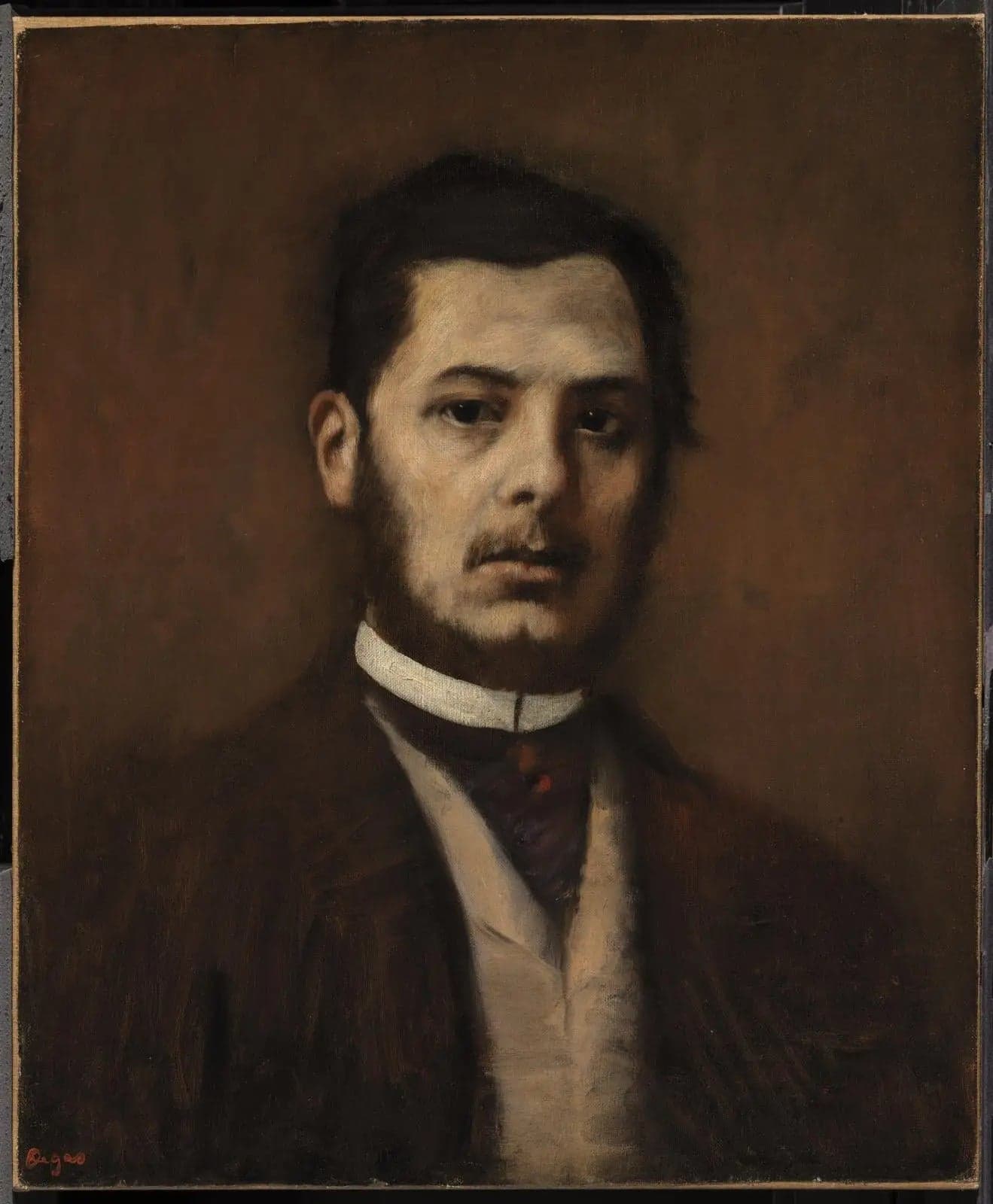
Portrait of a Man
- Original dimensions
- 64.8 x 86.4 cm
- Museum
- Brooklyn Museum
- Year
- 1866
Scene depicted
"Portrait d'homme" transports us into an intimate scene, where light caresses the subject's face, revealing both the depth and fragility of the human being. Degas captures meticulous details, from the folds of a garment to the delicate nuances of the skin, offering the viewer a direct immersion into the soul of his model.
Historical context
Created in 1866 in Paris, the painting "Portrait d'homme" by Edgar Degas is part of the Impressionist movement, a period marked by the experimentation of colors and lights. This masterpiece capturing a moment of power and intimacy is now located at the Brooklyn Museum , where visitors can admire the depth of this painting and its indelible artistic legacy.
Place in the artist's career
This painting represents a turning point in Degas's career, showcasing his growing mastery of portraits. Compared to works such as "The Dance Class" and "Absinthe," "Portrait d'homme" illustrates the artist's stylistic progression, moving from an academic representation to a more free and expressive interpretation.
Anecdote
Edgar Degas once stated: "Painting is a momentum, a passion, a reflection of the soul." This perfectly evokes the genesis of this composition, born on a sunny morning as he observed a man in a Parisian alley. This fleeting moment came to life on his canvas , enigmatic and vibrant with emotion.