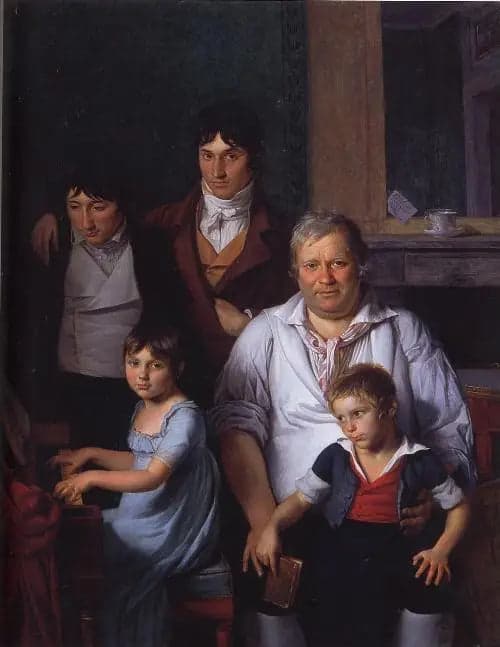
Portrait of a man and his children - Jacques
- Original dimensions
- 127 x 160 cm
- Movement
- Neoclassicism
- Museum
- Musée de Tessé
- Year
- 1800
Scene depicted
In this masterpiece, Jacques-Louis David presents us with an intimate moment, where a father stands beside his children. Their exchanged glances, filled with love, immerse us in the family dynamic strengthened by the social revolutions of the time. Every gesture, every expression is an ode to fatherhood, magnifying the bond between generations while reflecting the values of the era.
Historical context
Created in 1800, at the heart of the French Revolution that shook France, this painting resonates with the aspiration for a new social and artistic order. Jacques-Louis David , an emblematic figure of neoclassicism , captures a timeless essence in his artwork . Currently housed in the Musée de Tessé, this piece measuring 127 x 160 cm offers us a penetrating look at a time of great upheaval.
Place in the artist's career
This painting is situated at the peak of David's career, representing not only a key period of his artistic maturity but also a transition between his revolutionary works and his historical compositions. Alongside “ The Oath of the Horatii ” and “ The Death of Socrates ”, this portrait testifies to a significant evolution both technically and emotionally in his art .
Anecdote
“The painting is the reflection of the soul, light a promise,” David might have said while recalling the inspiring morning when he observed a caring father with his children. This fleeting moment, forever frozen in the painting , embodies tenderness and familial solidarity.