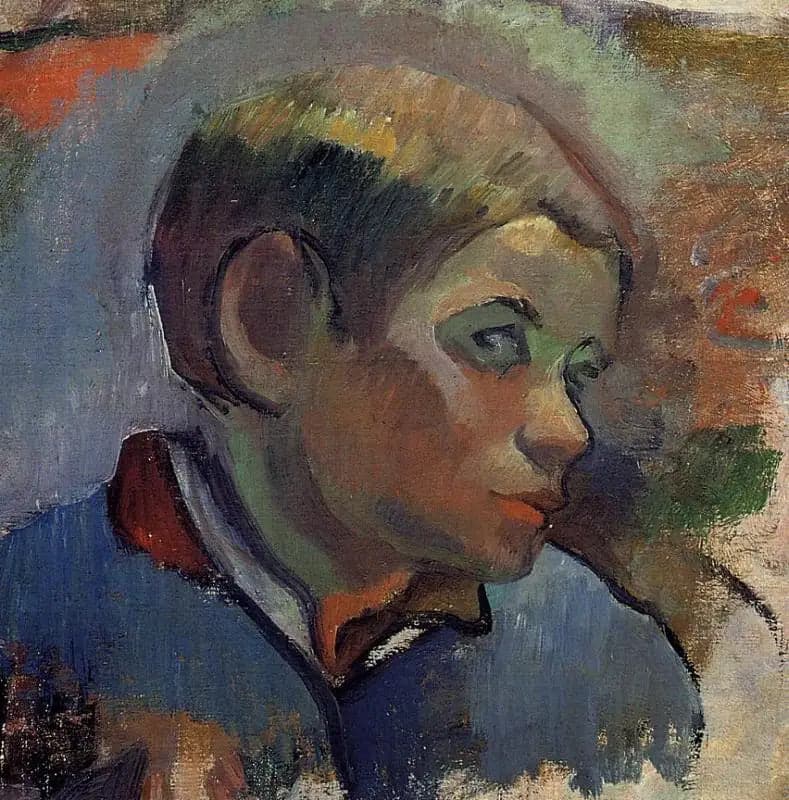
Portrait of a Little Boy
- Original dimensions
- 22 x 21 cm
- Museum
- Bemberg Foundation
- Year
- 1888
Scene depicted
This painting evokes the sweetness of childhood through the innocent face of a little boy, carrying a rare intensity and depth. The softened contours and touches of light create a contemplative atmosphere. This portrait, full of life, captures the spontaneity of childhood while revealing Gauguin's ability to transform ordinary reality into sublime art.
Historical context
This painting , created in 1888, belongs to the post-impressionist movement and reflects the artistic evolution of Paul Gauguin during his time in Pont-Aven, Brittany. At that time, the artistic movement was rooted in a search for pure colors and simplified forms. The painting resides today at the Bemberg Foundation , where it regains its brilliance, while being displayed in a city rich in culture and history.
Place in the artist's career
The Portrait of a Little Boy marks a pivotal period in Gauguin's career, who would later move on to bolder and more symbolist compositions. When compared to works like The Vision of the Sermon and The Yellow Christ , one observes a gradual evolution of his style, revealing a deep emotional richness, enhanced by his painting technique and a vibrant palette.
Anecdote
Paul Gauguin reportedly said: "I want to paint worlds, not men." This phrase summarizes his artistic approach. The inspiration for this pictorial work springs from an unusual encounter in nature, where light caresses the faces of carefree children, drawing powerful emotions from every exchanged glance.