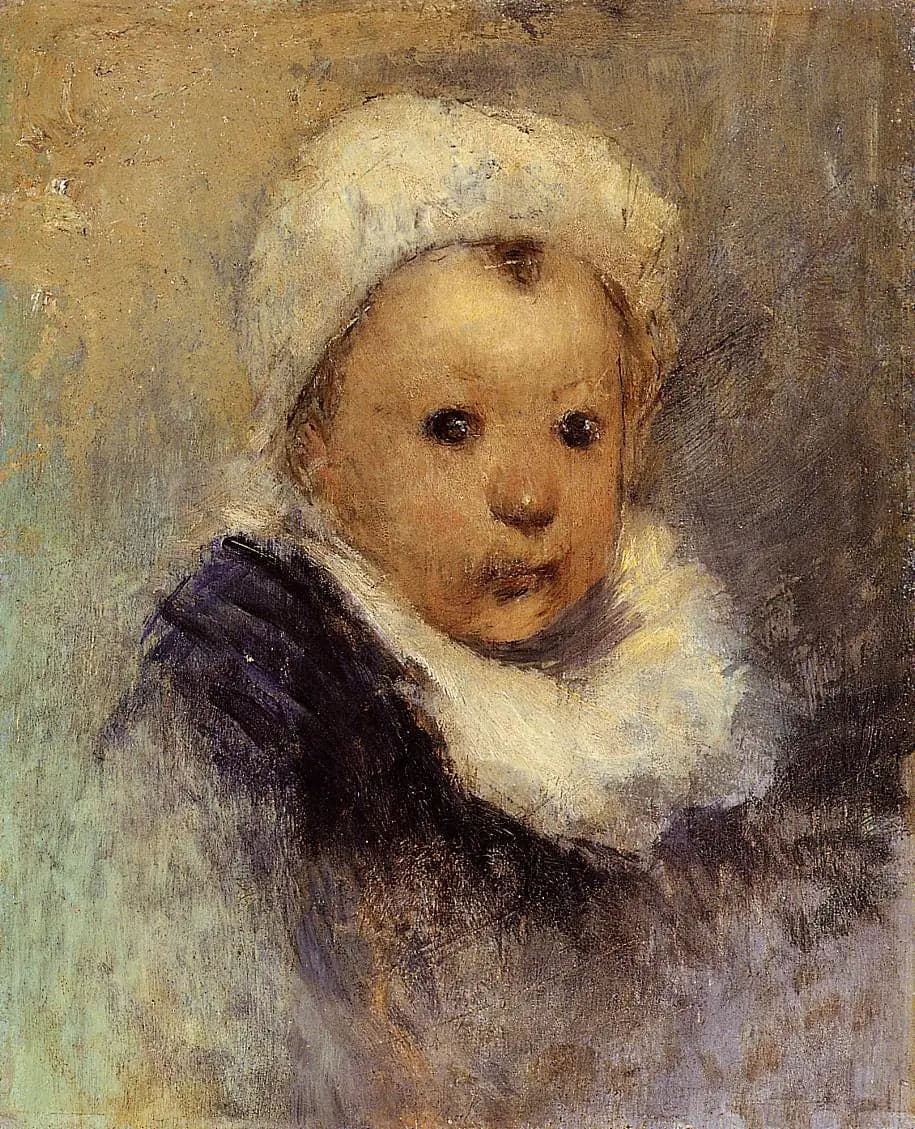
Portrait of a Child, Perhaps Aline Gauguin
- Original dimensions
- 21.5 x 27 cm
- Museum
- Not specified
- Year
- 1877
Scene depicted
This canvas , emblematic of Gauguin's art, tells the innocence and wonder of childhood. The little girl, probably Aline, is depicted with an expression that is both serene and curious, immersed in a world made of mysteries and discoveries. The discreet background gives way to her luminous face, thus accentuating the purity of the moment. This pictorial work evokes the simplicity and beauty of childhood in a changing world.
Historical context
Created in 1877, this painting is set in the vibrant context of the city of Paris, the artistic capital of France. Paul Gauguin , a beacon of post-impressionism , offers through this canvas , an intimate vision, a frozen moment of the family scene of the time, marked by a strong current of emotions and reflections on childhood.
Place in the artist's career
The canvas “Portrait of a Child, Perhaps Aline Gauguin” represents a key milestone in Gauguin's career, heralding his deep reflection on subjectivity and color. After more conventional compositions, this painting embodies his quest for creative freedom. In the economy of means of “Vision after the Sermon” and the colorful explorations of “The Montagne Sainte-Victoire,” Gauguin begins to forge an inimitable style.
Anecdote
“Every face is a story, every gaze an unfulfilled dream.” In the soft light of a spring morning, Gauguin captures Aline's face with unprecedented tenderness, an inspiration perhaps sprung from a simple street in Montmartre, imbued with life, color, and promises.