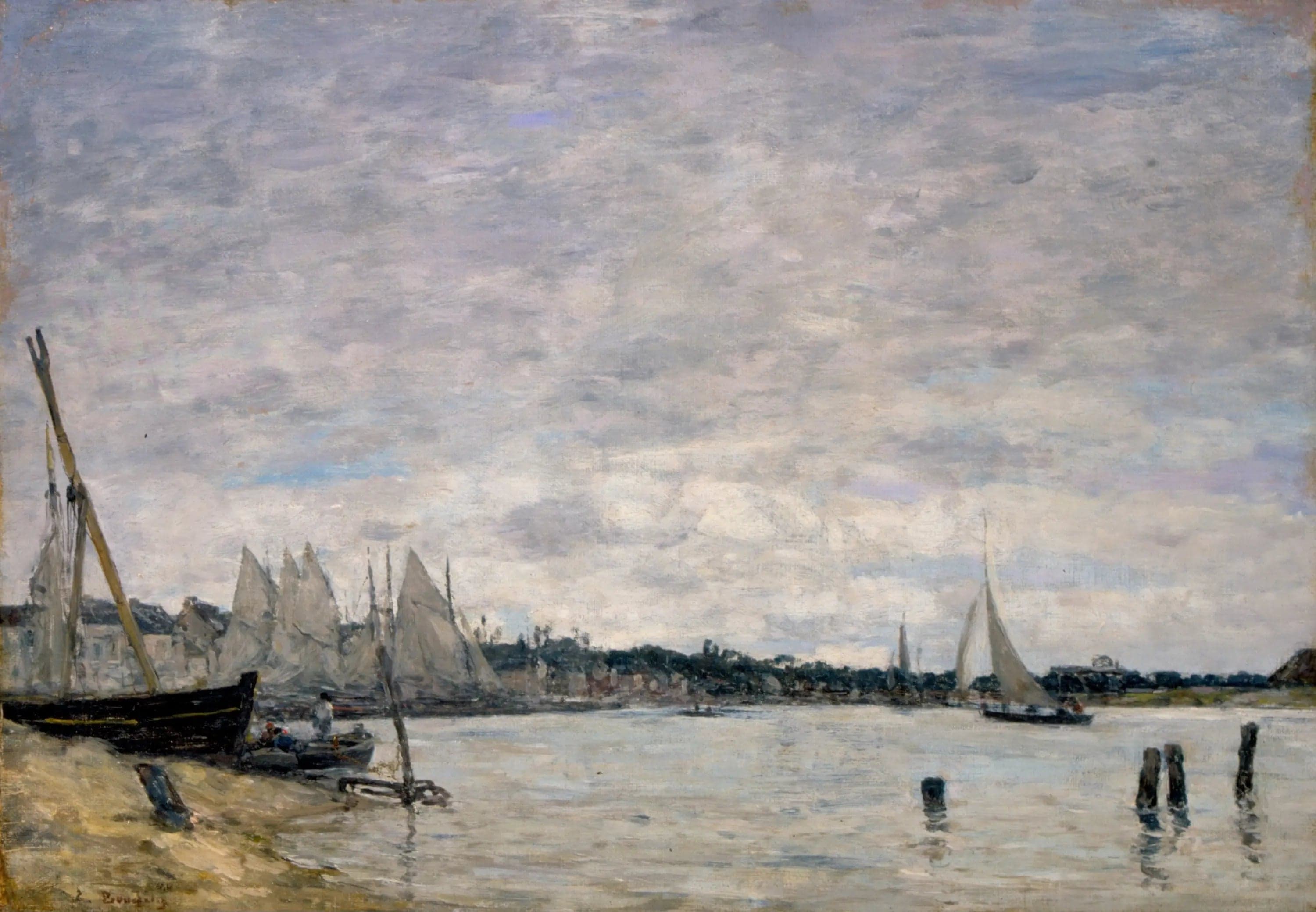
Port of Trouville
- Original dimensions
- 57.6 x 30.7 cm
- Museum
- National Gallery of Scotland
- Year
- 1873
Scene depicted
In Port de Trouville , the canvas depicts the lively life of the port, where boats gently sway on the sparkling waters. The white sails blend with the bluish hues of the sea, while human figures gracefully outline the shore, evoking the bustle of a summer day. The light seems to dance, revealing and concealing at the same time, creating a lively and vibrant atmosphere.
Historical context
Created in 1873, this iconic work finds its origin in Trouville-sur-Mer, a charming coastal town in Normandy, France. While fitting into the emerging Impressionist movement, Port de Trouville bears witness to a time when artists sought to capture the light and immediacy of outdoor scenes. Currently, this painting is displayed at the National Gallery of Scotland, where it attracts admiring glances from visitors around the world.
Place in the artist's career
Port de Trouville is part of Boudin's mature period, marking a decisive turning point in his style. Approaching works such as La Plage de Trouville and Les Bateaux à Honfleur , this canvas reveals the artist's technical evolution in terms of light and color, demonstrating a sensitivity that will continue to influence generations of painters.
Anecdote
“My inspiration comes from the changing skies and the soft lights that the sea offers,” could have said Eugène Boudin one delicate morning, surrounded by the gentle murmur of the waves. It is in this tranquility that his masterpiece , Port de Trouville , was born, a composition imbued with emotion that illustrates the fleeting beauty of nature.