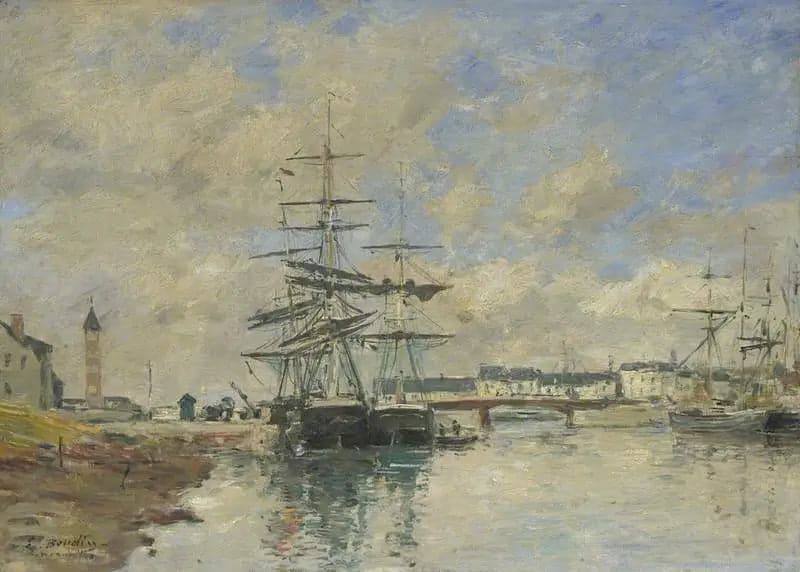
Port of Deauville
- Original dimensions
- 37.8 x 46.7 cm
- Museum
- Cleveland Museum of Art
- Year
- 1891
Scene depicted
The painting “Port de Deauville” evokes a lively day by the sea, full of light and promises. The sailboats are peacefully moored while the port workers bustle about, all bathed in an unprecedented brightness. Boudin, with a keen eye, offers us a window into a world where nature and humanity coexist in harmony, immersing us in the serene atmosphere of the Normandy coast.
Historical context
Created in 1891, this painting is a vibrant testimony to the Normandy coast, where Eugène Boudin , a precursor of the Impressionist movement, captures the effervescence of the port of Deauville. In a period where light and color were becoming increasingly important, this canvas stands out for its depth and modernity. It currently resides at the Cleveland Museum of Art , a place for preserving global artistic heritage.
Place in the artist's career
Set in a pivotal period of his career, this painting marks the peak of Boudin's artistic evolution. Compared to other iconic works such as “Plage de Trouville” and “The Landing of the Swimming School,” one perceives a constant search for light and emotion, reflecting his avant-garde approach. Each painting is a step in his journey towards Impressionism , a celebration of nature in all its splendor.
Anecdote
“The light on the sea is a poem without words,” could have said Eugène Boudin while contemplating the morning hues over the port. In creating this masterpiece , he captured the magical moment of a sunrise, where boats gently dance on the waves while the fresh sea air intoxicates the senses. It is at this precise moment that the painting comes to life, revealing the ephemeral beauty of a transcendent reality.