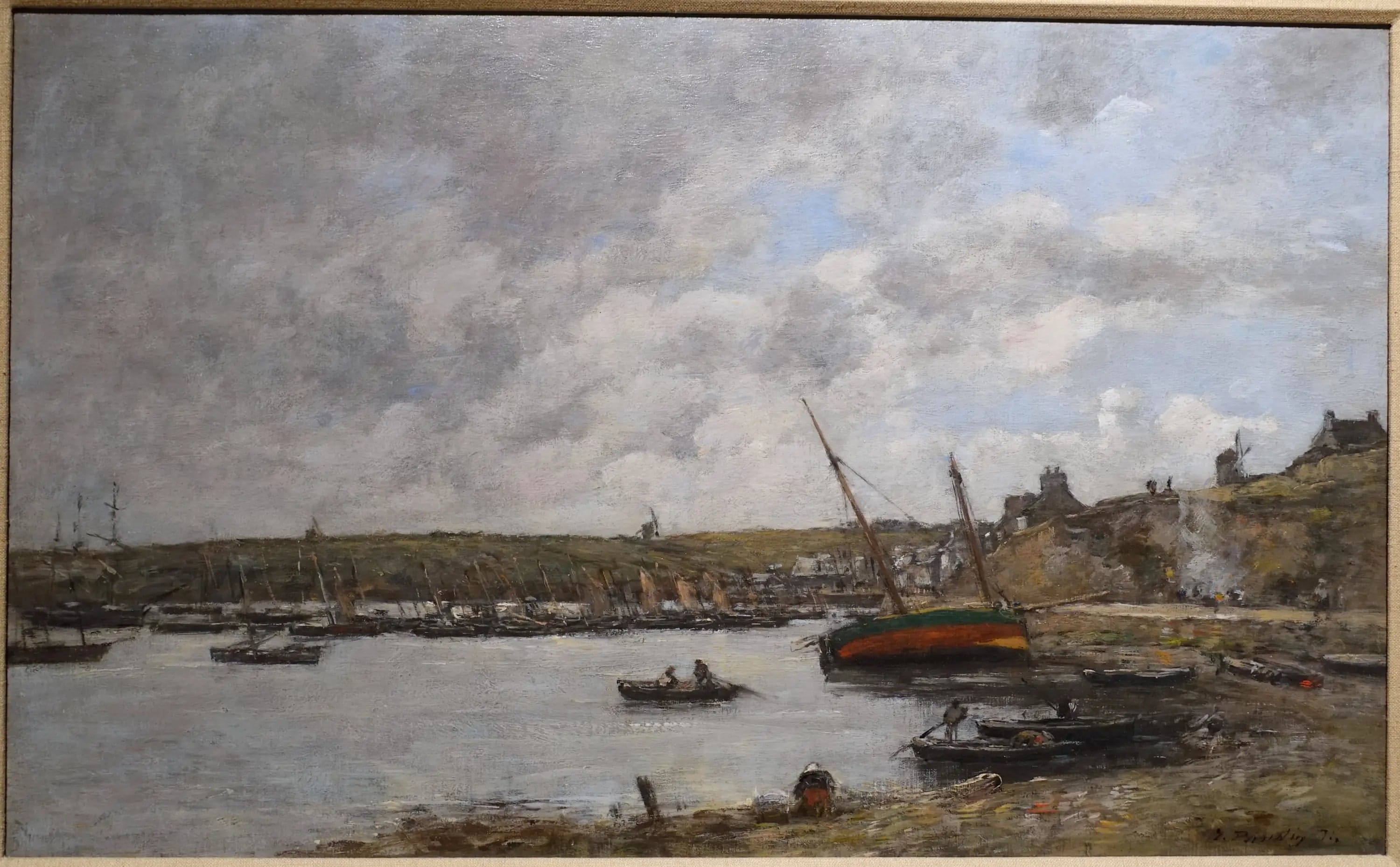
Port of Camaret
- Original dimensions
- 64 x 39.5 cm
- Museum
- Portland Museum of Art
- Year
- 1871
Scene depicted
The painting "Port de Camaret" reveals a marine scene where fishing boats and sailboats dance under the rays of a brilliant sun. The canvas evokes the serenity of the port, where marine elements blend harmoniously with the activities of fishermen. The dynamics of movement, skies, and waters intertwine, offering a vivid vision of a moment frozen in time, a moment of peace and harmony.
Historical context
Created in 1871, the painting "Port de Camaret" is an emblematic work of the artist Eugène Boudin , a pioneer of the Impressionist movement. This painting is set in the charming port of Camaret-sur-Mer, in Brittany, a region that has inspired many artists with its breathtaking seascapes. Currently exhibited at the Portland Museum of Art, this painting measuring 64 x 39.5 cm showcases Boudin's genius in capturing the soul and light of the sea.
Place in the artist's career
This painting marks a crucial step in the career of Eugène Boudin , who asserts himself here as a master of light and color. Compared to his other works, such as "Plage de Trouville" and "La Seine à Argenteuil," "Port de Camaret" highlights his evolution towards greater expressiveness, while remaining true to his technique of informal observation of nature.
Anecdote
"Every brushstroke is a caress to nature," Boudin might have said while contemplating the morning light on the port. It is in this painting that the artist, awed by the raw beauty of the scene, sought to capture not just an image, but a vibrant atmosphere of tranquility and movement. "Port de Camaret" is the result of a moment of inspiration where nature seems to whisper in the gentle morning breeze.