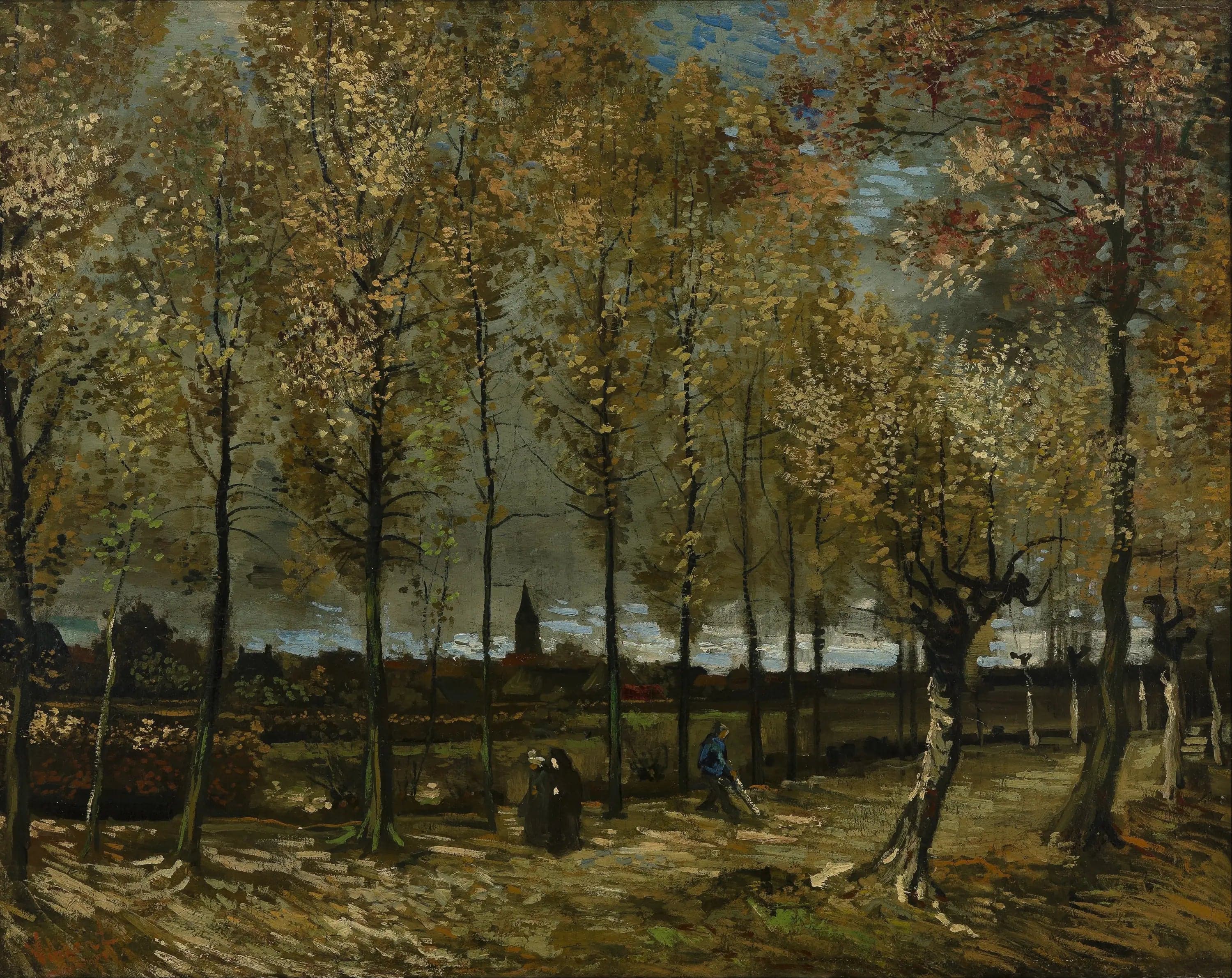
Poplars near Nuenen
Scene depicted
In “Poplars near Nuenen ,” Vincent van Gogh depicts an iconic rural scene, revealing rows of poplars stretching towards the infinite sky. The composition of majestic trees and vibrant hues banded on the canvas suggests a constant dialogue between man and nature, while guiding each visualization to a moment of inner peace. This painting illustrates the artist's quest to capture the beauty of the familiar landscapes that inhabited him.
Historical context
Created in 1885, this painting emblematic is born in Nuenen , a Dutch village that becomes the fertile ground of Vincent van Gogh 's creativity. Inscribed in the movement of post-impressionism , this pictorial work resonates with the soul of the place at a time when the artist desperately seeks his visual identity. Currently, the painting rests in the Boijmans Van Beuningen Museum , a prestigious institution in Rotterdam, where it is carefully preserved. Its imposing dimensions of 98 x 78 cm give this canvas an undeniable and majestic presence.
Place in the artist's career
“Poplars near Nuenen ” represents a pivotal moment in Vincent van Gogh 's career, a period when he begins to define himself as a unique artist. Located between “ The Potato Eaters ” and “ The Starry Night ,” this painting embodies Van Gogh's stylistic evolution, his transition to a brighter palette and a more expressive brush technique.
Anecdote
“Nature has never betrayed me,” Vincent might have said while contemplating the poplars of Nuenen one spring morning. It is there, among the soft sound of leaves in the wind, that he draws his inspiration to create this masterpiece , an ode to the simple beauty of the nature surrounding him. The light filtered through the foliage in the azure sky evokes the intense emotions that the artist feels through this painting .