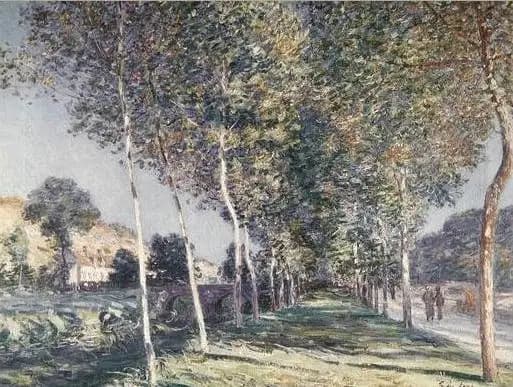
Poplar Avenue near Moret-sur-Loing
- Original dimensions
- 81 x 65 cm
- Movement
- Impressionism
- Museum
- Orsay Museum
- Year
- 1890
Scene depicted
This painting illustrates a majestic avenue of poplars, proudly standing at the edge of a peaceful path, inviting the viewer's gaze to wander into the distance. The play of light and shadow, typical of the Impressionist touch, creates an atmosphere of fullness, where time seems suspended. The composition makes us feel the softness of a quiet stroll, in tune with the seasons and the moods of the sky.
Historical context
Created in 1890, this painting, deeply rooted in the Impressionist movement, evokes the serenity of the landscape of Moret-sur-Loing, a small town located in the Île-de-France region. At this time, Sisley establishes himself as one of the masters of Impressionism , delicately capturing the light and atmosphere typical of bucolic scenes. Currently housed at the Orsay Museum , this masterpiece measuring 81 x 65 cm transports us through the ages, echoing the timeless charm of this painting.
Place in the artist's career
This painting marks a key moment in the career of Alfred Sisley , reflecting a growing technical mastery. Alongside The Seine at Argenteuil and The Bridge at Vétheuil , this painting reveals the evolution of his style, characterized by vibrant, almost dreamlike landscapes, where light plays a central role. Sisley asserts himself here as one of the great codifiers of Impressionism .
Anecdote
“Nature is my greatest master,” could have said Alfred Sisley one spring morning in Moret-sur-Loing, when the sunlight pierced through the leaves of the poplars. This passion for nature resonates with the evocative strength of his pictorial work , where each element of the landscape seems to vibrate with a breath of life.