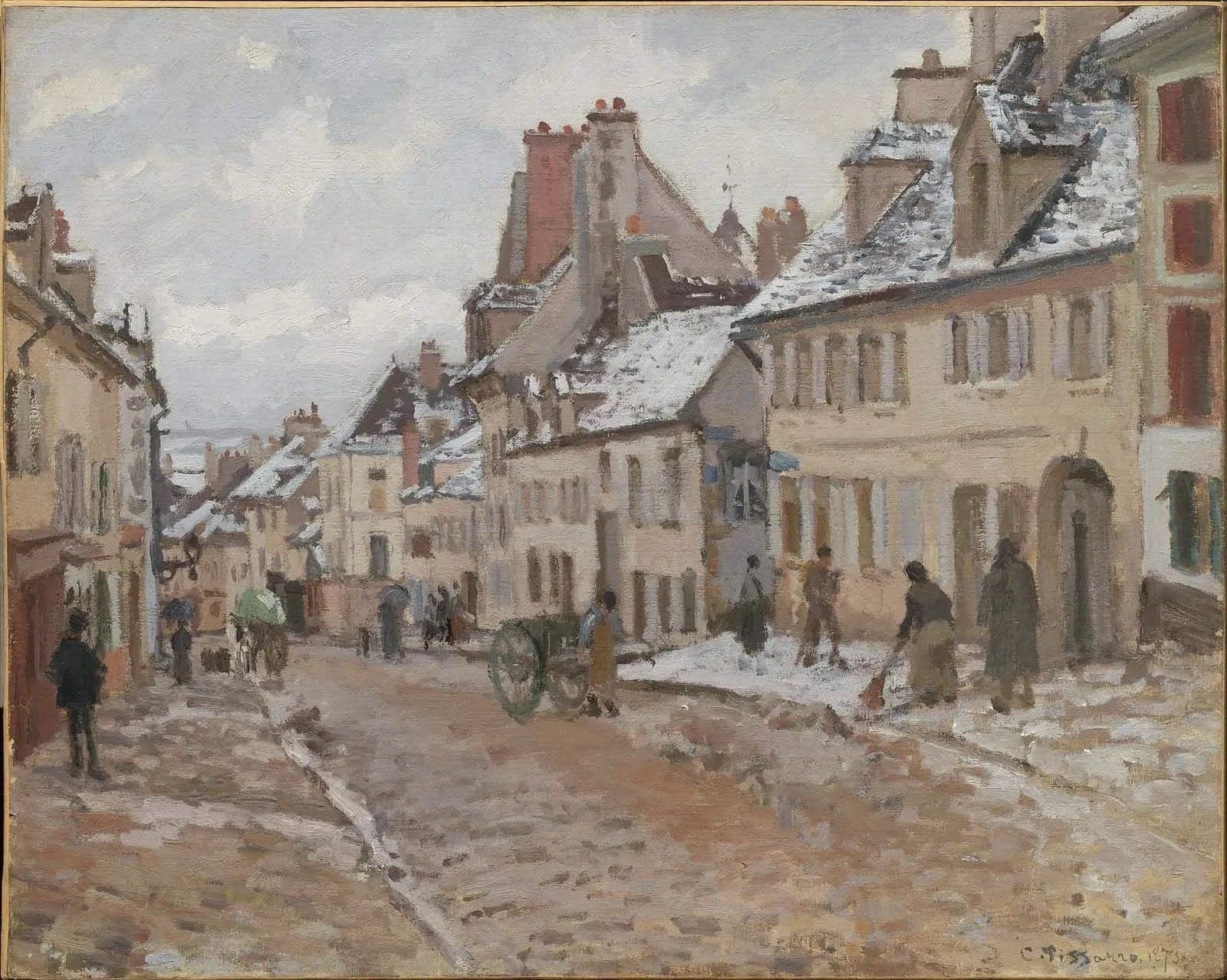
Pontoise, the path to Gisors in winter
- Original dimensions
- 73.7 x 59.7 cm
- Museum
- Museum of Fine Arts, Boston
- Year
- 1873
Scene depicted
The painting “Pontoise, the Path of Gisors in Winter” offers a graphic representation of a peaceful winter scene, where bare trees line a barely trodden path. The canvas captures the silvery reflections of light on the snow, while distant shapes blend into a Siberian fog, suggesting the calm and serenity of a moment frozen in time. Each brushstroke evokes a silent, almost meditative ambiance, revealing a nature that is both alive and mute.
Historical context
Created in 1873, this painting is a striking reflection of Pontoise, a small French town located in the Île-de-France region. Registered in the Impressionist movement, this painting bears witness to a significant moment in art history where artists began to boldly explore the nuances of light and landscape. Currently exhibited at the Museum of Fine Arts, Boston , this masterpiece, measuring 73.7 x 59.7 cm, captures the essence of a tranquil winter on the Path of Gisors.
Place in the artist's career
“Pontoise, the Path of Gisors in Winter” represents a significant milestone in the career of Camille Pissarro , witnessing his stylistic development as a master of Impressionism . Alongside works such as “Boulevard Montmartre, Spring” and “Pissarro's Garden in Éragny,” he demonstrates an evolution towards an increasingly delicate technique, capturing real emotions through a personal landscape.
Anecdote
“Art does not reproduce the visible; it makes visible,” said Camille Pissarro . Inspired by the wintry atmosphere enveloping Pontoise, he captured a morning where sunlight pierced through the veil of snow, revealing delicate shadows on a peaceful landscape. This painting , a legacy of this introspection, evokes a fleeting and poignant beauty.