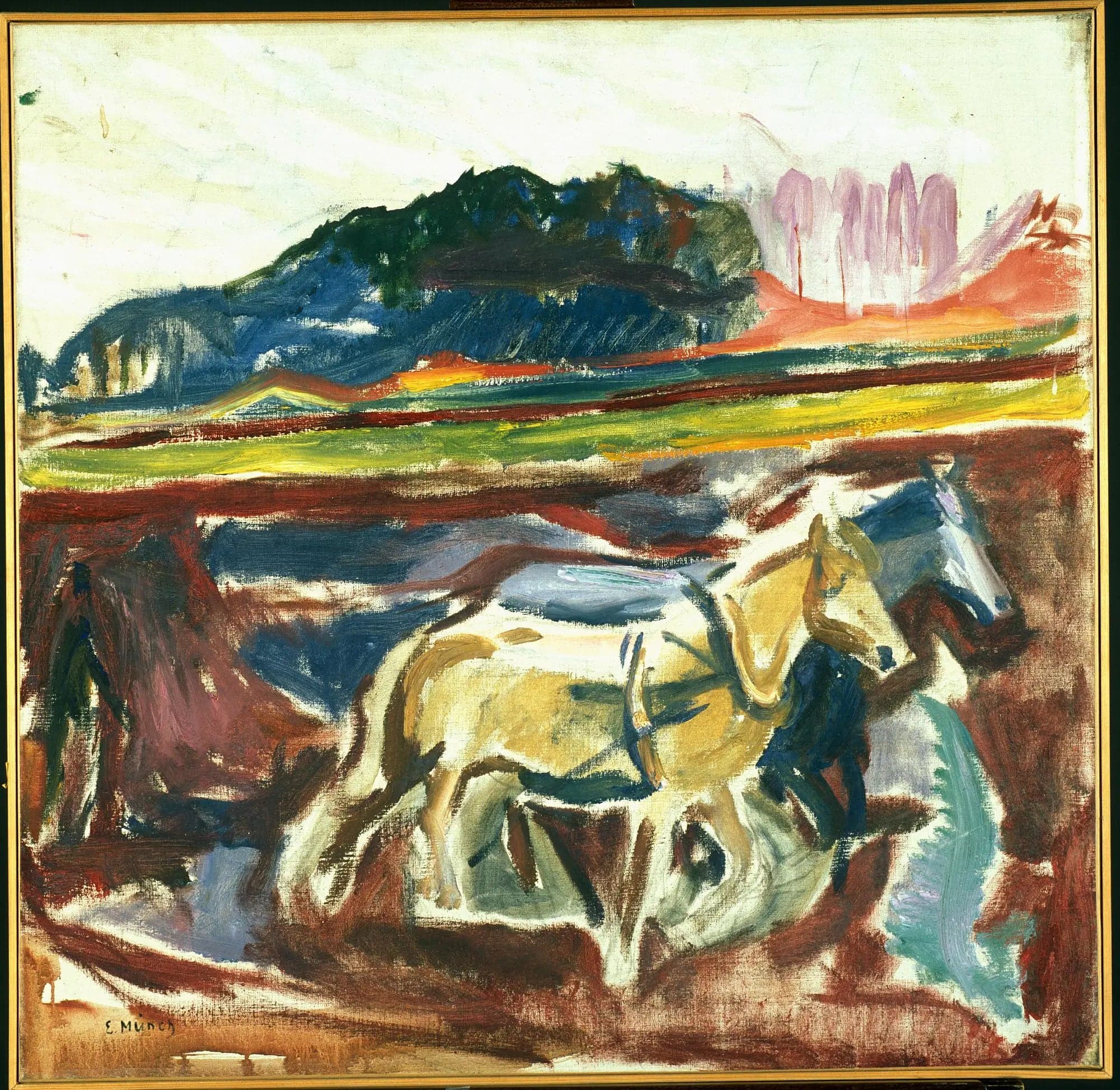
Plowing Horses
- Original dimensions
- 141 x 120.5 cm
- Museum
- Munch Museum
- Year
- 1919
Scene depicted
This captivating painting captures a bucolic scene where two horses work the land. Beyond its figurative aspect, Working Horses evokes the complex harmony between man and nature. The animals, elegant and powerful, traverse a fertile field while the sky, tinted with soft light, adds an almost spiritual dimension to this pictorial work. This frozen moment encapsulates a simple yet daily reality, transcended by Munch's mastery.
Historical context
Created in 1919, Working Horses finds its roots in Oslo, a vibrant city of the expressionist movement. At that time, Munch settled in his studio in Ekely, where the surrounding nature strongly influenced his artistic choices. The painting, currently exhibited at the Munch Museum, embodies not only a time of deep reflection but also a style that resonates with human emotions, through its impressive dimensions.
Place in the artist's career
Working Horses fits into a mature period of Munch's career, where his themes explore human struggle and the connection with nature. Comparatively, works like The Scream and The Madonna highlight his concerns in a more dramatic way, while Working Horses displays a serene poetry, reflecting a fascinating technical and emotional evolution.
Anecdote
Edvard Munch often said: "Painting is for me a way to capture the ephemeral, the hidden beauty in the everyday." Imagine him, immersed in the golden light of a spring morning, drawing inspiration from the hardworking horses pulling their carts, a metaphor for the fighting spirit of human existence. This original emotion nourishes the evocative power of Working Horses .
Major exhibitions
Munch og Ekely: 1916-1944