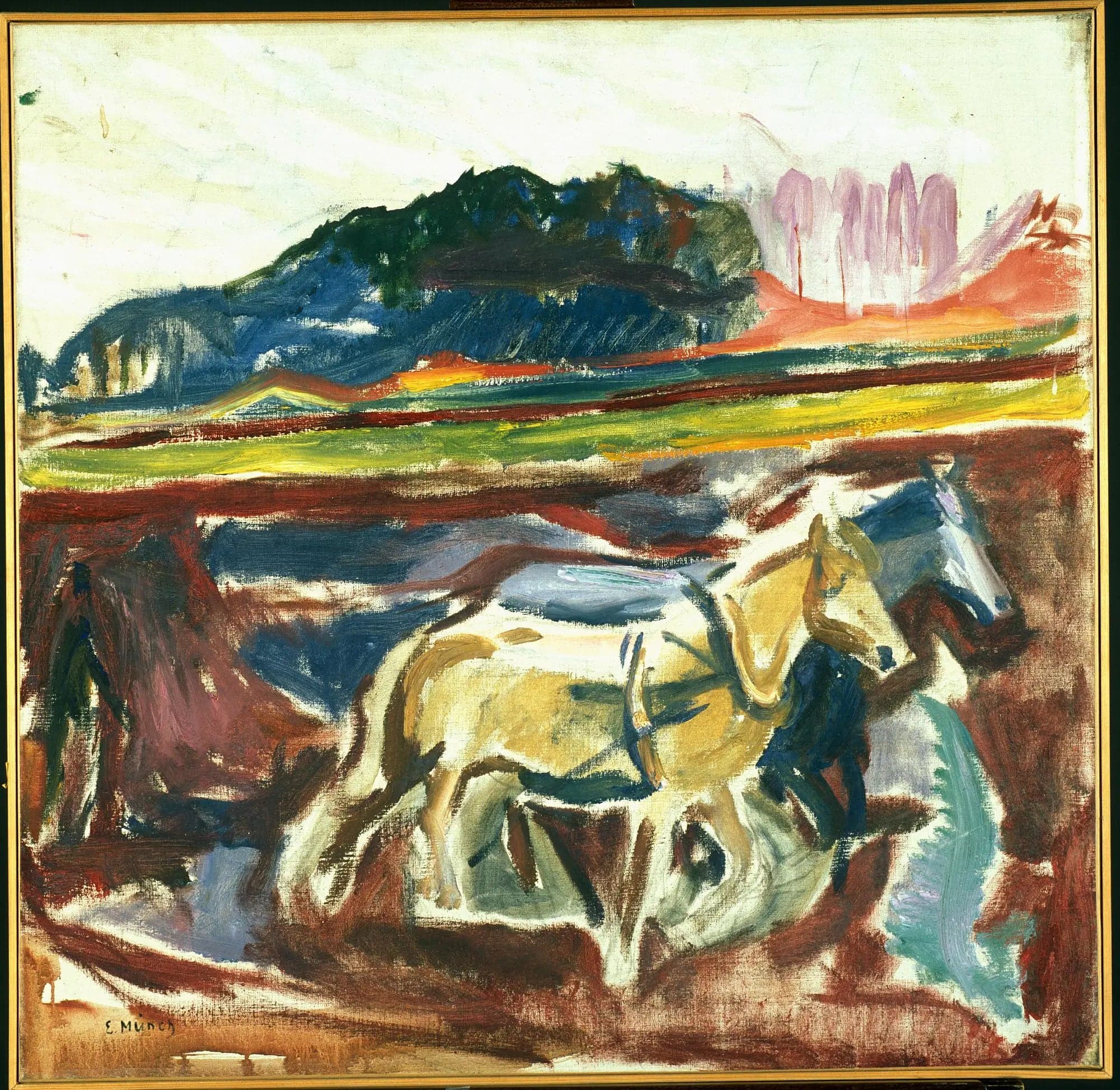
Plowing Horses
- Original dimensions
- 88 x 86 cm
- Museum
- Munch Museum
- Year
- 1916
Scene depicted
The canvas “Working Horses” highlights a lively scene where the horses, powerful and majestic, pull a plow behind them, furrowing the dark and rich earth. The composition illustrates the harmony between man and nature, while emphasizing the hard work that agricultural life represents. Munch manages to capture not only the animal energy but also the depth of human emotions through this simple yet powerful moment.
Historical context
Created in 1916, this painting is the result of a prominent artist of the expressionist movement. Located in Oslo, this iconic work stands within the Munch Museum, a sanctuary dedicated to the invaluable legacy of the artist. The canvas, containing all the intensity of the era, presents itself with dimensions of 88 x 86 cm, unique for its artistic and historical value.
Place in the artist's career
This painting fits into a period of maturity for Munch, revealing his themes of struggle and authenticity. Alongside other works such as “The Scream” and “The Madonna,” it illustrates how Munch has evolved, moving from a subjective style to a deeper exploration of human emotions. These paintings show a stylistic continuity, hinting at his exceptional artistic journey.
Anecdote
“The world lights up when the spirit unfolds.” In a quiet alley in Oslo, on a sunny morning, Munch was inspired by the power of nature, seeing the working horses as a symbol of human struggle and communion with the earth. This painting is not only a canvas but also an ode to life and its challenges.