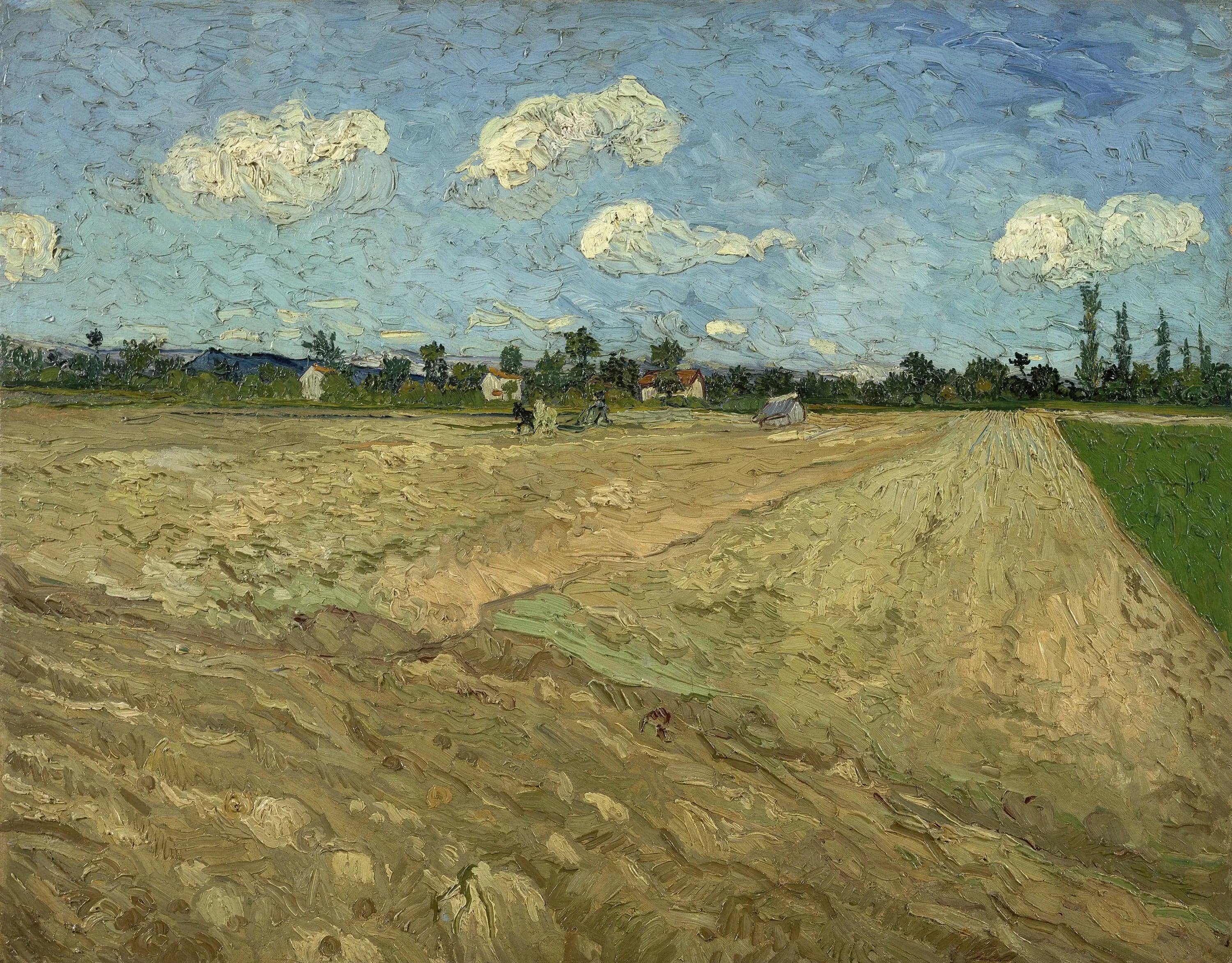
Plowed Fields
Scene depicted
In Plowed Fields , the painting opens onto a vast expanse of land brilliantly worked by farmers, with well-defined furrows spreading under a bright sky. This painting exudes rural life, celebrating hard work and the harmony between man and nature. The rich texture of the canvas seems to vibrate with the breath of the wind, bringing a sense of movement and energy in every shade of color.
Historical context
Created in 1888, this painting is set in the heart of southern France, in Arles , in a context deeply marked by Impressionism . The painting Plowed Fields represents a period when Vincent van Gogh sought to capture the beauty of rural landscapes , merging his intense emotions with the reality of fertile fields. Currently, this masterful canvas is located at the Van Gogh Museum , where it is admired for its impressive dimensions: 81 x 65 cm.
Place in the artist's career
Plowed Fields stands as an important milestone in the career of Vincent van Gogh , illustrating his Arles period where he merges simple forms and vibrant colors. Alongside The Starry Night and The Sunflowers , one perceives the evolution of his style, a search for ever more emotional depth, transcending realism to explore light and emotions.
Anecdote
“Nature is my most beautiful companion,” he might have said while contemplating the landscape of Arles under the morning light. It is here, in the warmth of this locality, that he was struck by the vibrant beauty of the plowed fields. Each brushstroke of this masterpiece is imbued with the passion and tranquility that these landscapes provided him.