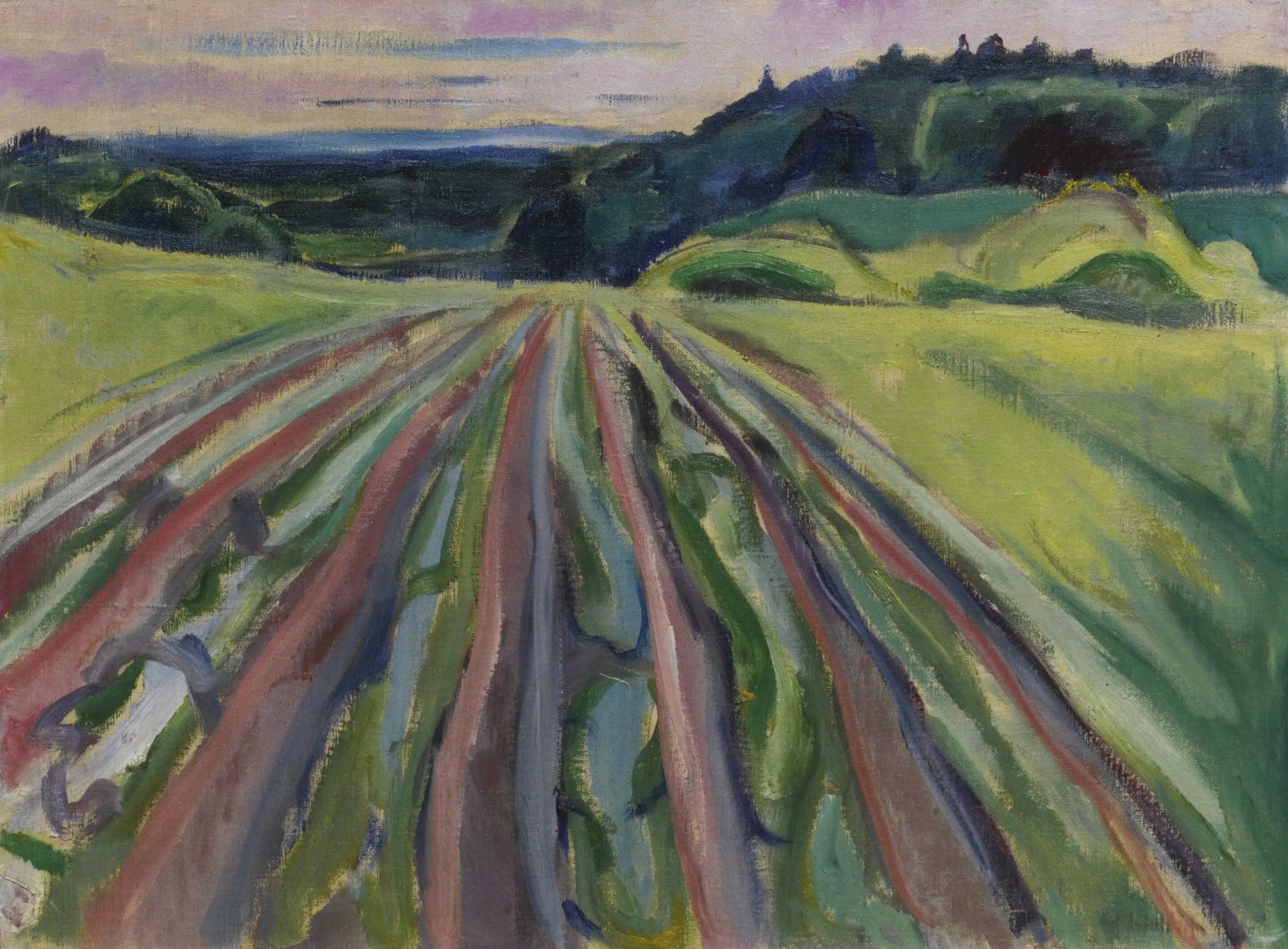
plowed field
- Original dimensions
- 89.5 x 88 cm
- Museum
- Munch Museum
- Year
- 1916
Scene depicted
This pictorial work reveals a vast expanse of plowed land, where human silhouettes are busy. The shadows of the earth blend with the bent bodies, powerfully illustrating the daily toil and the fragile harmony between man and nature. The scene immerses us in a rural world, heavy with promises and struggles, where every detail tells an ancestral story.
Historical context
Created in 1916, in Oslo, this painting is emblematic of the expressionist movement, a period marked by a quest for intense emotions and psychological depths. Now present at the Munch Museum, the canvas captures the essence of the agricultural world, while resonating with the turmoil of its time.
Place in the artist's career
The canvas “Plowed Field” marks a key stage in Munch's career, representing a synthesis of his stylistic evolution. When compared to works like “The Scream” and “The Dance of Life,” one perceives the evolution of his technique, moving from the exploration of the psychological to a representation more grounded in the tangible world.
Anecdote
“Nature is a cry, a dance of the soul,” said Edvard Munch . It is on a vibrant morning, shrouded in mist and melancholy, that he let his brush capture the moment of a laborious life in Plowed Field . With each brushstroke, it is his breath that he lays down, a palpable intimacy between the artist and his subject.