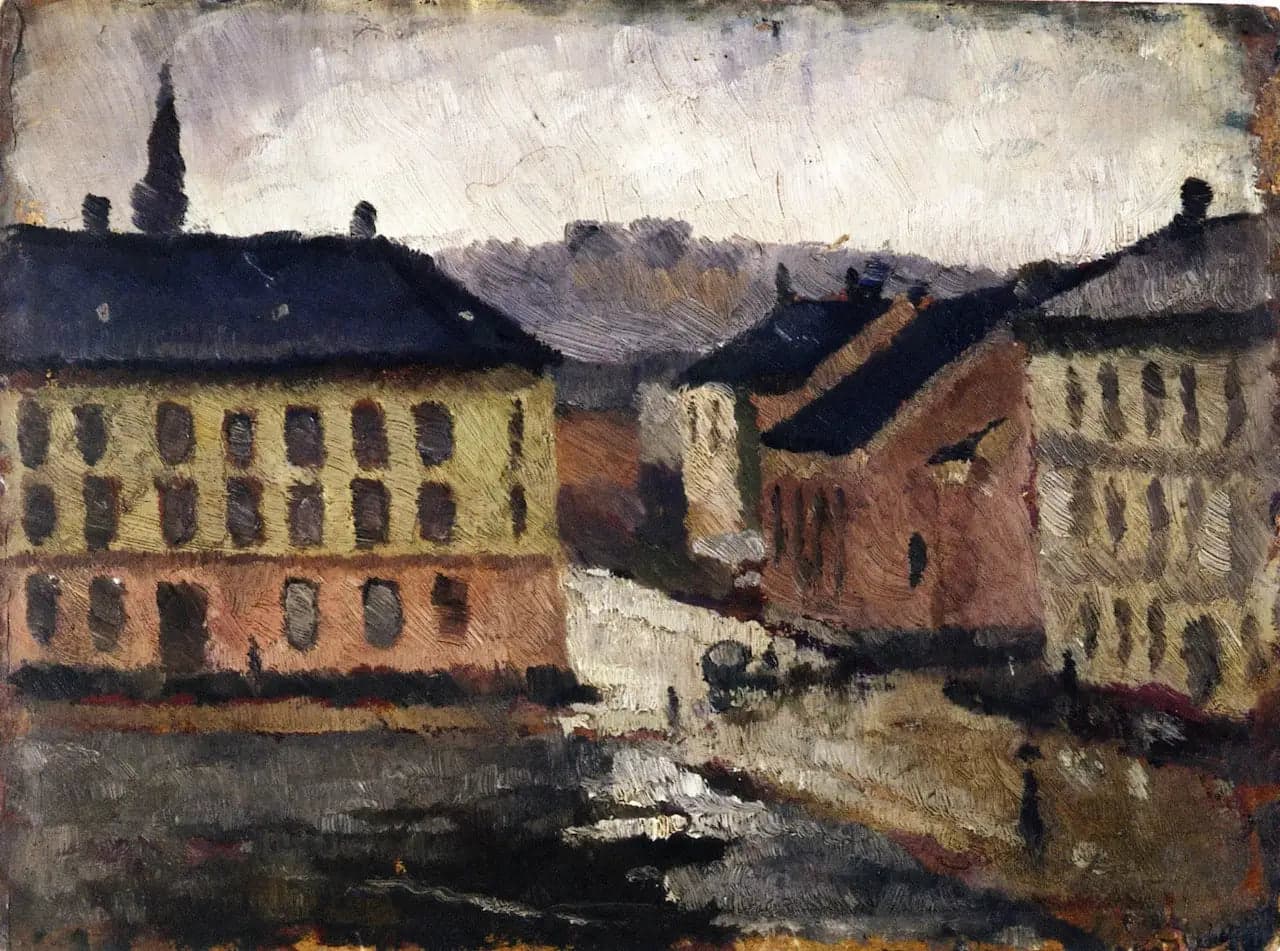
Place Olaf Rye to the Southeast
- Original dimensions
- 29.5 x 22 cm
- Museum
- private collection
- Year
- 1882
Scene depicted
This painting illustrates a soothing and introspective view of Place Olaf Rye, revealing subtle nuances of urban daily life. The work depicts elements of nature and Norwegian architecture, reflecting an introspective dialogue between man and his environment. It is a fleeting moment, captured in the painting , where the fragile beauty of the present moment asserts itself as an obvious truth.
Historical context
Created in 1882, this painting is the result of the genius of Edvard Munch , an artist rooted in the expressionist movement. The canvas captures the silent essence of the city of Oslo, Norway, at a time when human emotions and melancholies found their voice in art. Currently, this painting is preserved in a private collection, a rare gem for art lovers. With dimensions of 29.5 x 22 cm, it exudes an aura of intimacy and contemplation.
Place in the artist's career
Place Olaf Rye towards the Southeast marks a crucial milestone in Munch's career. Situated in a period of stylistic maturation, this canvas establishes a dialogue between earlier works, such as The Madonna and The Scream, and other future masterpieces. This painting testifies to a breakthrough towards a more personal and poignant expression, capturing the very soul of expressionism .
Anecdote
“Art is the quest for a truth beyond what the eye sees.” This quote resonates deeply when thinking of the painting Place Olaf Rye towards the Southeast. Imagine Munch, wandering the alleys of Oslo, inspired by the light of an April morning, as the dappled shadows dance gently on the cobblestones, all forming the emotional genesis of this remarkable pictorial work.