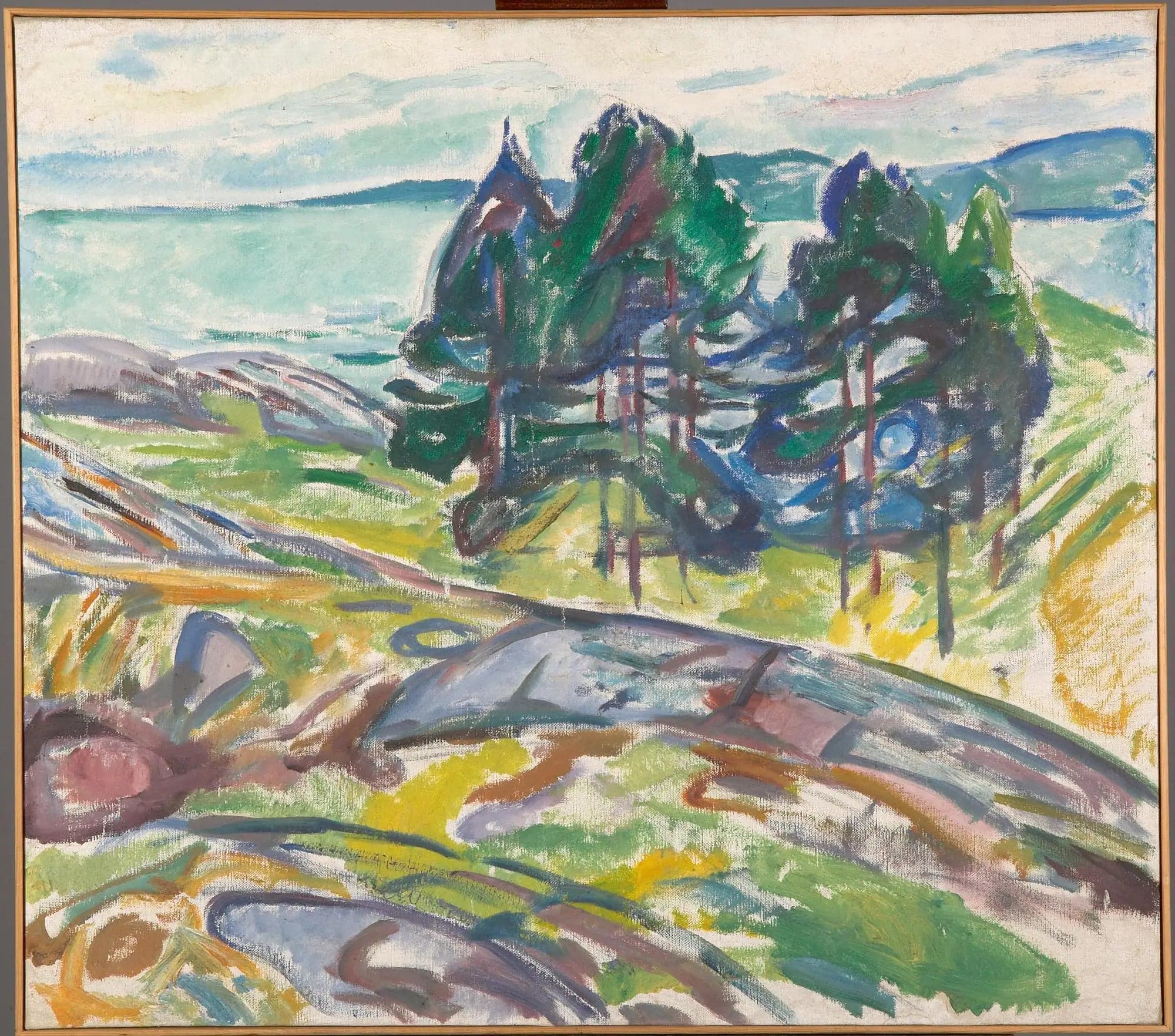
Pins by the Sea
- Original dimensions
- 99.5 x 88.5 cm
- Museum
- Munch Museum
- Year
- 1911
Scene depicted
In this painting , Munch transports us to a shore where tall pines stand majestically against the horizon of a calm ocean. The shades of green and blue blend into the painting to evoke both serenity and melancholy, creating a dialogue between the earthly and aquatic elements.
Historical context
Created in 1911, the painting "Pines by the Sea" is part of the expressionist movement, emblematic of the 20th century, born in Oslo, Norway. This pictorial work, now preserved in the Munch Museum, reflects the emotional exploration of the artist, capturing the unique atmosphere of a troubled era where art sought to grasp the human soul in all its complexity.
Place in the artist's career
"Pines by the Sea" represents a crucial step in Munch's artistic evolution. This inventive composition, alongside earlier works like "The Scream" and "The Madonna," reveals a shift from a dramatic vision of the human condition to a more contemplative and introspective approach, marking a period of intense creativity.
Anecdote
"Art does not aim to represent the visible, but to make visible the invisible," is said to have declared Edvard Munch while contemplating a sunrise, inspired by the golden light caressing the sea. This fleeting moment led him to capture the essence of the canvas , where each tree, each sea breeze, tells a vibrant and poignant story.