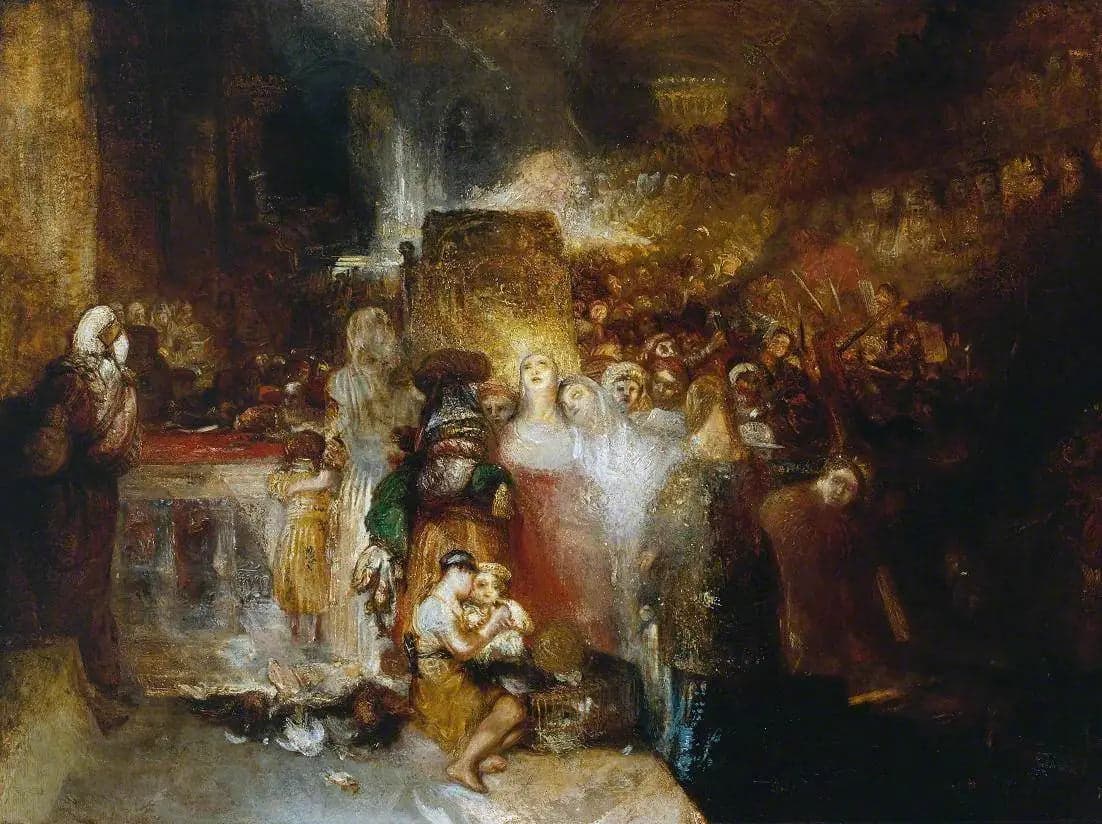
Pilate Washing his Hands
- Original dimensions
- 91.4 x 121.9 cm
- Museum
- Tate
- Year
- 1830
Scene depicted
In this composition that stirs the heart, Turner immerses us in the midst of a biblical scene where Pontius Pilate, caught in a moral dilemma, washes his hands, symbolizing his abdication of responsibility. The air is charged with tension, while the figures in the background grapple with intertwined fates. The treatment of the characters and shadows creates an atmosphere of drama, urgency, and spirituality, typical of British art of the time.
Historical context
Created in 1830, this painting embodies the romantic movement, which is characterized by its exploration of emotion, the sublime, and the dramatic. In a context marked by the artistic effervescence of London, where Turner resided, this canvas inherits the socio-political upheavals of the time. Today, the painting rests within the prestigious Tate museum in London, where it attracts streams of visitors admiring the depth of the work.
Place in the artist's career
Pilate Washing his Hands represents a pivotal moment in Turner's career, marking his transition to a brighter and more emotional abstraction. Alongside works such as The Landing of the Fleet at Calais and Paradise Lost , this painting illustrates the evolution of his style, moving from a realistic approach to a bolder exploration of color and light.
Anecdote
“The light is there, always. It dances on every surface, on every soul…,” said Turner, inspired by the lights of a cold morning on the Thames. It is by observing the luminous ballet of reflections that the artist conceived the masterpiece that is Pilate Washing his Hands , a painting born from a moment suspended between the ephemeral and the eternal.