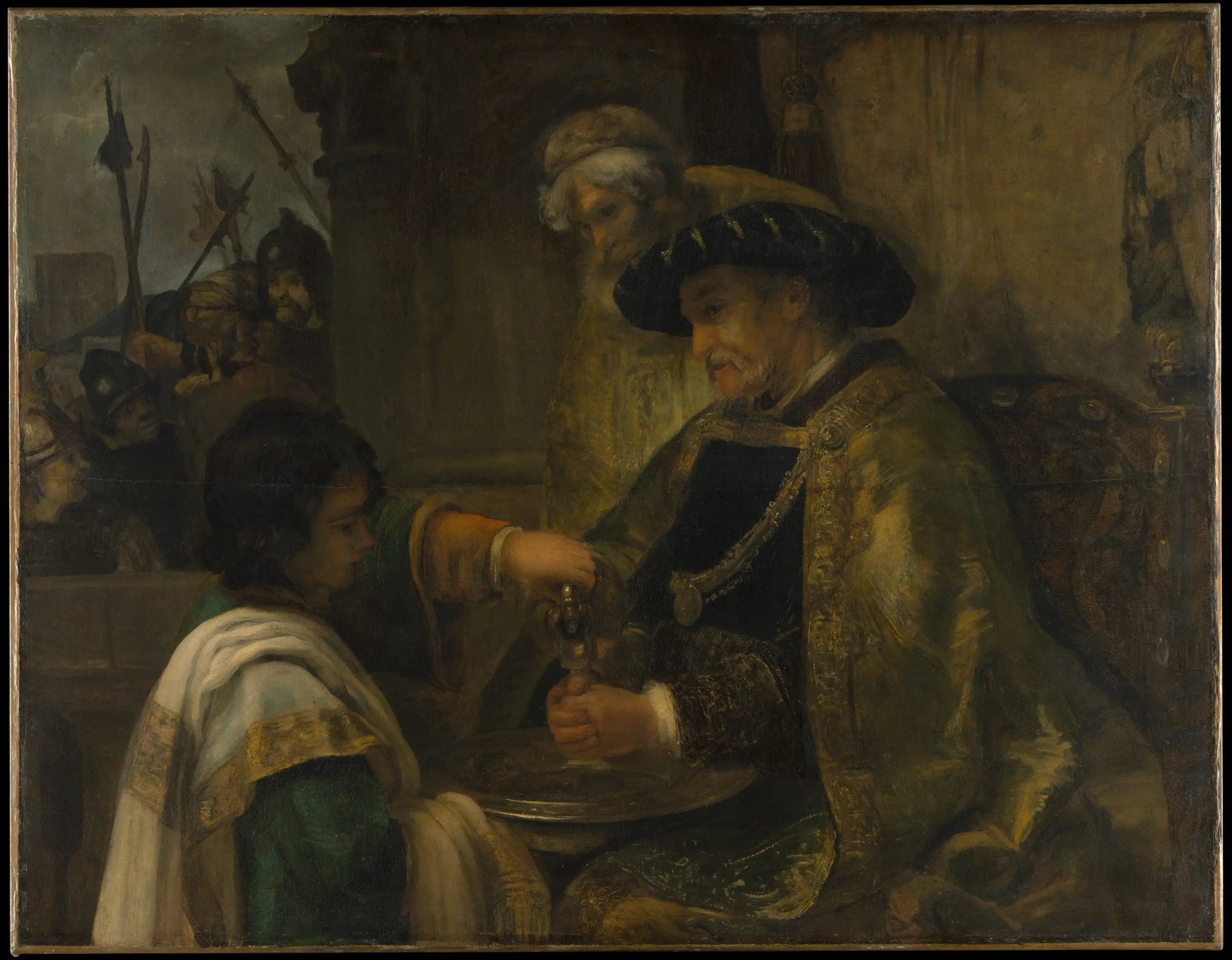
Pilate washes his hands
- Original dimensions
- 167 x 130.2 cm
- Museum
- Metropolitan Museum of Art
- Year
- 1660
Scene depicted
In this masterpiece, we witness a crucial moment in the biblical narrative, where Pontius Pilate, facing the crowd, washes his hands to assert his innocence regarding the condemnation of Jesus. This scene brilliantly illustrates the moral dilemma and the anguish surrounding it, revealing humanity in its heartbreaking choices. Rembrandt captures the tension with intensity through powerful visual expressions, making palpable the hope and tragedy.
Historical context
The painting emblematic of Rembrandt , dated 1660, emerges from Amsterdam, a major artistic hub of the baroque era. In this context, the city hosts an unprecedented intellectual and artistic effervescence. The canvas is an integral part of the baroque movement, celebrated for its dramatic lighting and emotional approach. Currently, this canvas is located at the Metropolitan Museum of Art , where it attracts art lovers from around the world with its impressive dimensions.
Place in the artist's career
“Pilate se lave les mains” represents a major milestone in the career of Rembrandt , illustrating the maturity of his style and artistic expression. It sits between his early works, such as “The Night Watch,” marked by a dynamic burst of light, and his later compositions, such as “The Anatomy Lesson of Dr. Tulp,” where a deeper introspection is revealed. This canvas bears witness to both technical and emotional evolution, capturing the essence of the human soul in dilemma.
Anecdote
“Every brushstroke is a dance between shadow and light, a whisper of hidden emotions,” said Rembrandt . The inspiration for this masterpiece came on a misty morning, where the artist, wandering through a peaceful alley, encountered faces marked by dramatic struggles, stories of guilt and innocence. Thus, the painting comes to life, vibrant with evocative force.