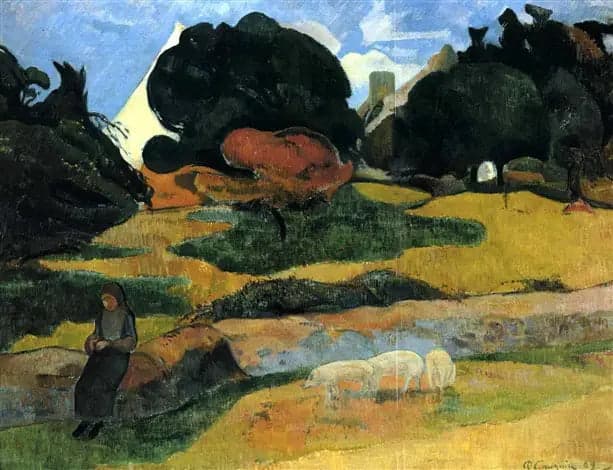
Pig Keeper
- Original dimensions
- 92 x 73 cm
- Museum
- Shizuoka Prefectural Museum of Art
- Year
- 1889
Scene depicted
On this canvas , the gaze is captured by a young girl, surrounded by her pigs, exuding the innocence and simplicity of rustic life. The scene evokes not only a rural landscape but also reveals a deep bond between man and nature. The animals, in complete tranquility, are a symbol of peace and harmony, contrasting with the turbulent modernity of the time. Every detail of this pictorial work immerses us in a world where the everyday becomes poetic.
Historical context
Created in 1889, the painting Pig Keeper by Paul Gauguin is set against a backdrop of a world in full transformation. At that time, Gauguin was in Pont-Aven, a Breton commune that became the cradle of synthetism. This artistic movement moves away from academic norms to allow for a more free and personal expression. The canvas , now preserved at the Shizuoka Prefectural Museum of Art, bears witness to the vibrant color and bold outlines that characterize his style. The large dimensions of this canvas attract both the eye and the emotion it conveys.
Place in the artist's career
The painting Pig Keeper is situated at a turning point in Gauguin's career, marking his progression towards bolder and more expressive compositions. After this painting, he created other paintings such as Vision after the sermon and The Vision of the Sermon , where he explores even more intensely the dialogue between spirituality and nature. These works collectively chart a path towards his artistic maturity, making this canvas remarkable in his journey.
Anecdote
“The painting is a work of memory, a tale told through color and form.” These words resonate in Gauguin's mind as he captures, on a sunny afternoon, the image of a situation so simple and so rich: a young pig keeper, rooted in the rurality that surrounds her. This intimate moment, where he drinks in the beauty of the natural elements, marks a precious step in his artistic journey.