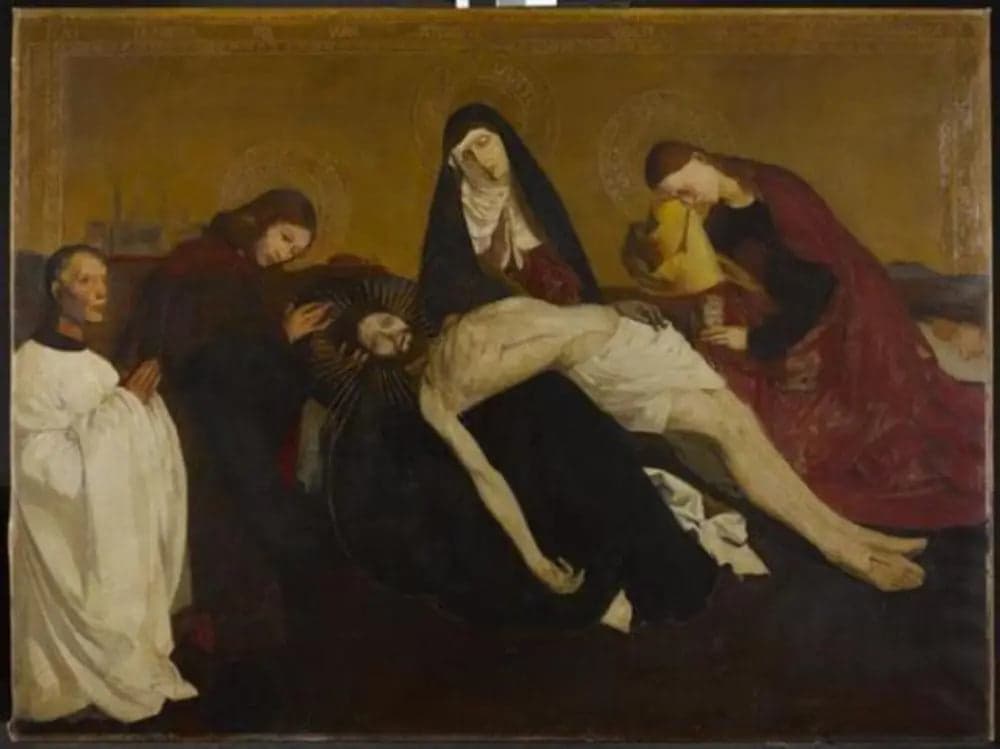
Pietà of Villeneuve-Lès-Avignon
- Original dimensions
- 140 x 105 cm
- Museum
- Art Museum of The Hague
- Year
- 1912
Scene depicted
The canvas represents a poignant depiction of compassion and melancholy. In this painting, the maternal figure guides our gaze towards the expression of suffering and redemption, a theme that resonates throughout human history. Each brushstroke, each nuance invites the viewer to an emotional reflection on the human condition.
Historical context
Year: 1912 |BRK| Museum: Art Museum of The Hague |BRK| Dimensions: 140 x 105 cm
Place in the artist's career
“Pietà de Villeneuve-Lés-Avignon” marks a turning point in Mondrian's career, a key stage in the blossoming of his unique style. Positioned between the painting “Composition II in Red, Blue, and Yellow” and “Broadway Boogie Woogie,” this painting transitions from his more figurative reflections to increasingly abstract compositions, reflecting a captivating emotional and technical evolution.
Anecdote
“Beauty lies in simplicity,” Mondrian might have declared during the awakening of his creativity one spring morning, contemplating the reflections of lights in an alley of Avignon. The inspiration behind this masterpiece lies in the artist's ability to capture the essence of his time, connecting spirituality to geometric structure, thus creating the evocative power of the painting .