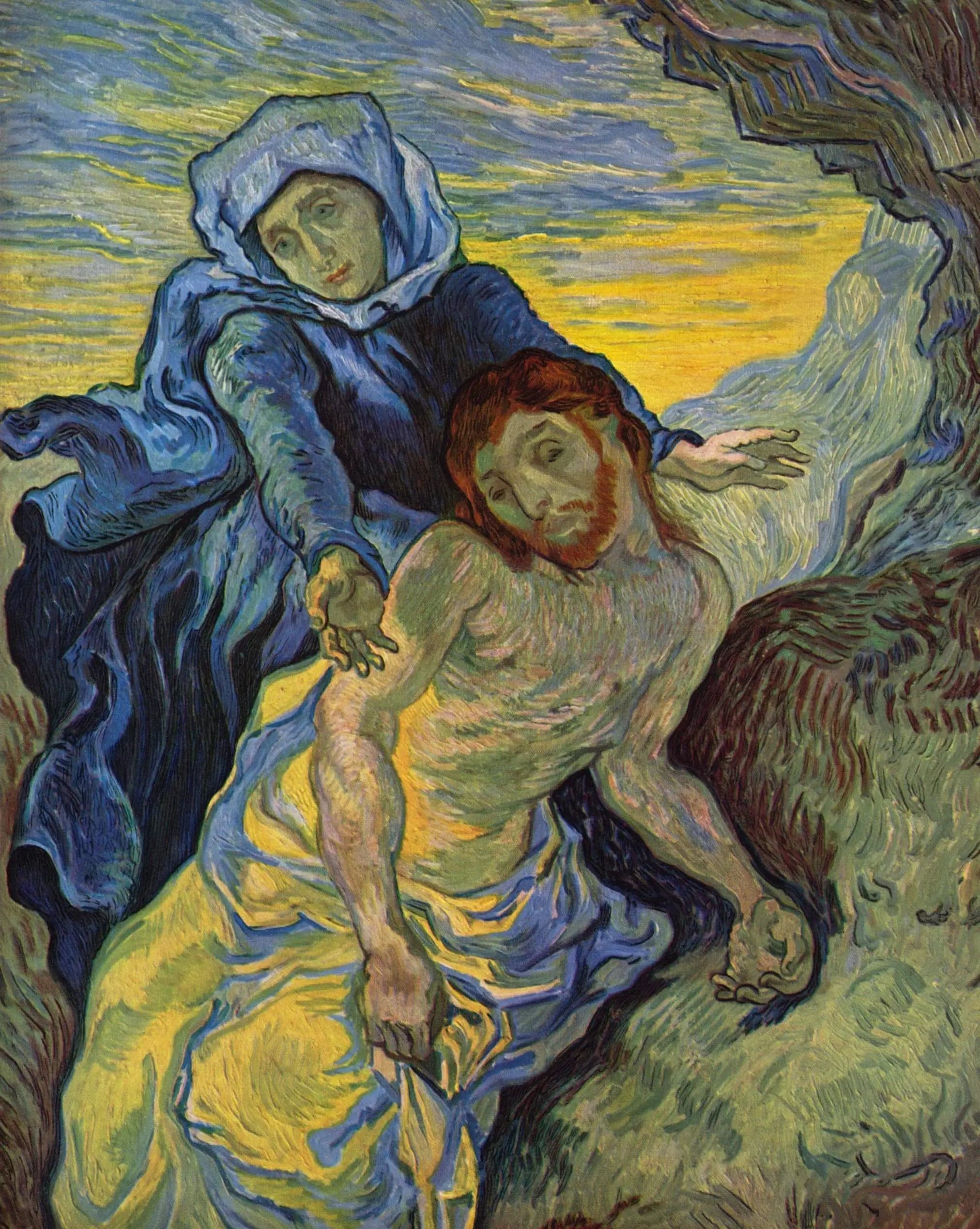
Pietà
Scene depicted
The painting "Pietà" depicts a moment of deep tenderness, where the maternal figure seems to embrace pain and despair with palpable softness. This painting transcribes a powerful duality: love in the face of suffering, reinforced by expressive brushstrokes and the dynamism of forms. The work invites the viewer to reflect on the human condition, beyond appearances.
Historical context
Created in 1889, the iconic Pietà by Vincent van Gogh is the result of a tumultuous and creative period, in the charming landscape of Saint-Rémy-de-Provence . Associated with post-impressionism , this pictorial work denotes an innovative search for light and color. Today, this valuable painting rests at the Van Gogh Museum , where it continues to inspire generations. With dimensions of 60.5 x 73 cm, this fragile representation illustrates the emotional strength of a bygone era.
Place in the artist's career
The Pietà is a significant milestone in the career of Vincent van Gogh , emerging during his period of creative maturity. It dialogues with other masterpieces such as " The Starry Night " and " The Sunflowers ", revealing a technical evolution where color and texture become vectors of expression. This painting illustrates his relentless quest for striking beauty, capable of transcending suffering.
Anecdote
Vincent van Gogh once said: "Painting is an expression that emerges from the depths of our being, like a secret voice." It was on a gentle autumn morning, cradled by the whisper of leaves, that the artist is said to have drawn his inspiration for this canvas , questioning the relationship with suffering and redemption, as he perceived them around him.