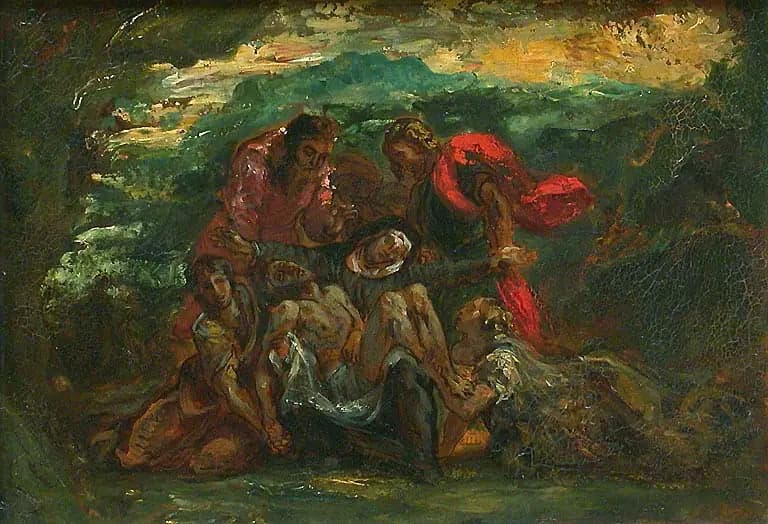
Pietà
- Original dimensions
- 42.5 x 29.5 cm
- Museum
- room 942
- Year
- 1843
Scene depicted
Delacroix's Pietà intensely captures a poignant moment: the Virgin Mary holding the lifeless body of Christ. This iconic composition evokes universal themes such as loss, love, and suffering, touching the soul of every viewer. The drapery of the garments, as well as the expressions on the faces, tell an emotional story to which everyone can relate.
Historical context
It was in 1843, in Paris, at the heart of a vibrant romantic movement, that Eugène Delacroix created his famous painting "Pietà". This pictorial work is now displayed in room 942 of a Parisian museum, showcasing the skill and passion of its creator. In this period where emotion breaks free from conventions, the canvas captures the very essence of human fragility.
Place in the artist's career
This painting places Delacroix at the heart of a brilliant career, marking a period of artistic maturity. Alongside Liberty Leading the People and The Massacre of Chios , Pietà testifies to the evolution of the artist's techniques, who knows how to blend reality and symbolism with unmatched finesse.
Anecdote
Delacroix once stated: "Color is my passion, it is my life." That morning, in the studio, light filtered through the curtains, creating dancing shadows on the canvas . Each brushstroke of the artist was imbued with deep emotion, his inspiration springing from memories of a beloved face. This work is much more than a painting , it is a cry from the heart.
Major exhibitions
Delacroix (1798-1863)