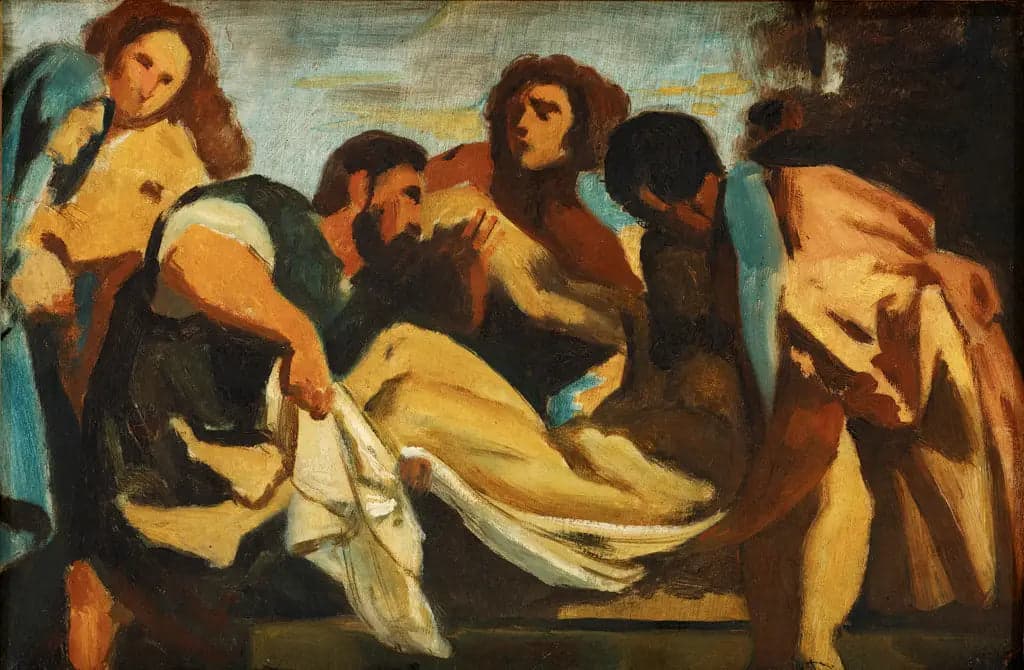
Pietà, after Titian
- Original dimensions
- 29.5 x 20 cm
- Museum
- Rhode Island School of Design Museum
- Year
- 1864
Scene depicted
The painting “Pietà, after Titian” poignantly illustrates the suffering of the Virgin Mary holding the lifeless body of her son, Jesus. The scene, imbued with sadness, is magnified by a studied composition, where dramatic light enhances the emotional contrast between maternal pain and the sweetness of eternal rest, reigning at the heart of the painting . The figures are sculpted with an intensity that transcends the mere frame of representation, connecting us to a universal humanity.
Historical context
Created in 1864, this painting is a precious witness of the city of Aix-en-Provence, the region where the great master Cézanne was born. As the world entered a modern era, this canvas is part of an artistic movement of profound richness, Post- Impressionism , blending innovation and tradition. The painting , currently preserved at the Rhode Island School of Design Museum , skillfully merges technique and emotion, capturing the painful and divine essence of the Pietà.
Place in the artist's career
This painting is part of a period where Cézanne, in search of a new artistic expression, experiments with forms and emotions. Positioned between "The Card Players" and "The Montagne Sainte-Victoire", this painting reveals a turning point in his way of expressing emotional depth, paralleling his capacity for stylistic transformation and his growing introspection.
Anecdote
“The painting must capture the human soul.” This phrase, resonating like an echo of passion, illustrates Cézanne's inspiration for this masterpiece . One spring morning, as light filtered through the veils of an old painting in a silent studio, he decided to plunge his brush into an ocean of emotions to bring his version of the Pietà to life. Thus, the evocative power of this canvas merges with the memories of lost souls, creating a space for reflection.